Part I
Daniel and Michael were brothers, but anyone who met them would never have guessed they grew up in the same house.
Daniel, the older brother, was quiet and responsible. He woke up early, went to work, paid bills on time, and rarely complained about anything. Michael, the younger brother, was cheerful and carefree. He loved making people laugh, spending time with friends, and living each day without worrying too much about tomorrow.
Their parents often compared them.
“Why can’t you be more responsible like Daniel?” their mother would ask Michael.
Whenever Daniel stayed silent during family conversations, their father would say, “You should learn from your brother. Michael knows how to enjoy life.”
Neither brother liked being compared, but they never spoke about it.
As they grew older, their lives became busier. Daniel found a stable job and continued living with their elderly mother after their father passed away. Michael moved to another part of the city, married, and started a family of his own.
Michael visited every Sunday. He usually arrived with fruit for their mother and toys for the children. The house became louder whenever he walked through the door. He joked with everyone, told funny stories, and made their mother smile.
Daniel usually stayed in the kitchen preparing food or fixing something around the house.
“Brother, sit down and relax,” Michael often said.
Daniel would shake his head. “Someone has to finish the work.”
Michael assumed Daniel preferred being busy. He never asked why his brother looked so tired.
Every month, Daniel paid for their mother’s medicine, electricity, food, and household repairs. He also quietly helped Michael whenever he had financial difficulties.
When Michael’s child needed school supplies, Daniel sent money. When Michael’s motorcycle broke down, Daniel paid for the repair. When Michael lost several days of work because he was sick, Daniel covered part of his rent.
Each time, Michael promised, “I’ll pay you back soon.”
Daniel always replied, “Don’t worry about it.”
Michael believed him. He thought his brother earned enough money and had no serious problems.
Whenever he asked, “Are you doing okay?”
Daniel always gave the same answer. “I’m fine.”
One Sunday afternoon, Michael arrived at the family home and noticed that Daniel was not there.
“Where is he?” Michael asked.
Their mother looked down at her hands. “He went to work.”
“On Sunday?”
“He has been working every Sunday for months.”
Michael frowned. Daniel had never mentioned it.
Later that evening, Michael waited until his brother returned home. Daniel walked through the door looking exhausted. His shirt was covered in dust, and his hands were rough and scratched.
Michael stared at him. “What kind of work were you doing?”
Daniel placed his bag on the floor. “Just some extra work.”
“Why do you need extra work?”
Daniel avoided his eyes. “It’s nothing. I’m fine.”
But this time, Michael did not believe him.
Part II
The next morning, Michael visited Daniel’s workplace. He did not tell anyone why he was there. He simply waited outside until Daniel came out for lunch.
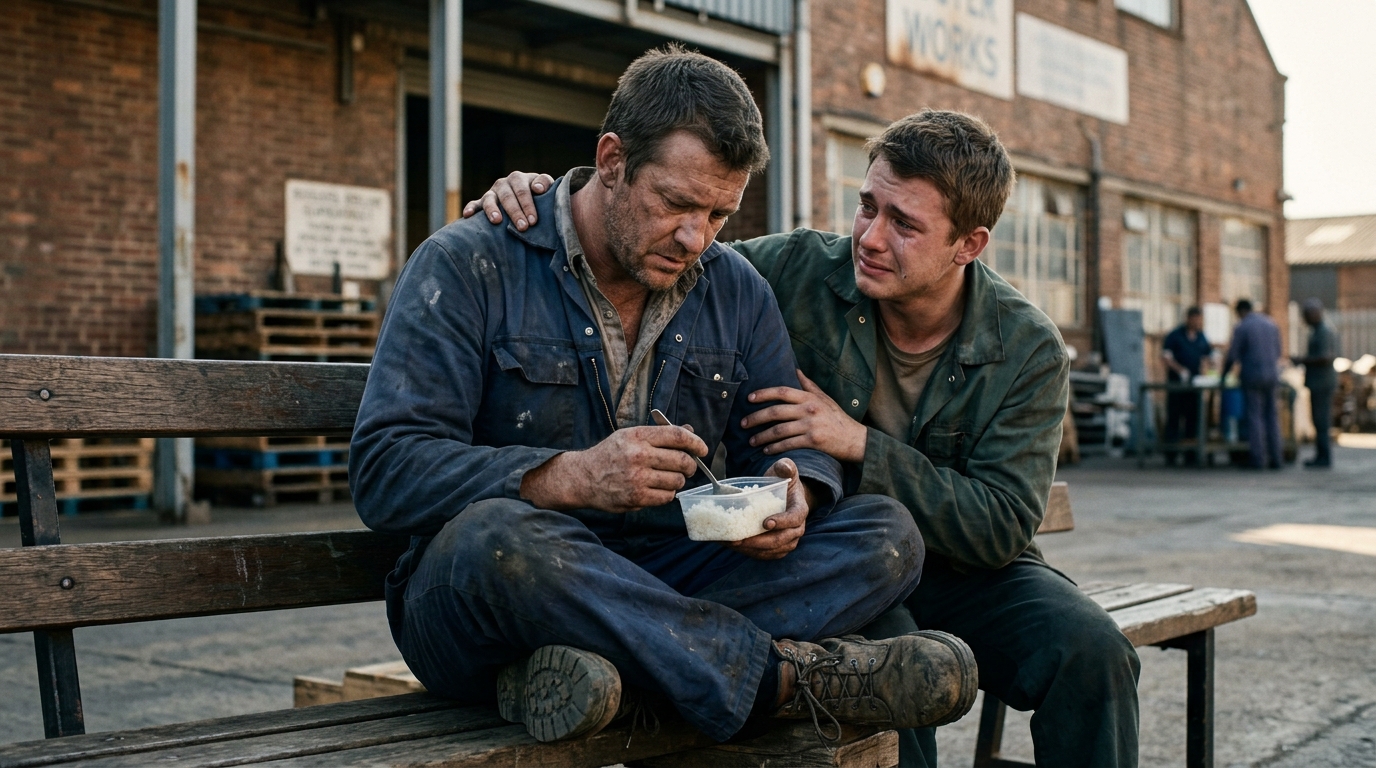
Michael watched his brother sit alone on a bench and eat a small container of plain rice. There was no meat and no vegetables—only rice with a little sauce.
Michael walked toward him. Daniel looked surprised.
“What are you doing here?”
Michael sat beside him. “I could ask you the same thing. Why are you eating this?”
Daniel closed the container. “I wasn’t very hungry.”
Michael looked at his brother’s worn-out shoes and faded shirt. Then he remembered the money Daniel had sent him only two weeks earlier.
“Tell me the truth,” Michael said. “What is happening?”
Daniel remained silent.
Michael’s voice became softer. “Please. Stop telling me you’re fine.”
Daniel looked away. For a long moment, neither brother spoke.
Finally, Daniel took a deep breath.
Their mother’s medical expenses had increased. The roof of the family house needed repairs before the rainy season. Daniel had also borrowed money to help Michael during a difficult year. He had been working extra shifts every weekend and skipping meals to repay the debt.
Michael felt as though the ground beneath him had disappeared.
“You borrowed money for me?”
Daniel nodded.
“Why didn’t you tell me?”
“You already had enough problems.”
“But you were suffering.”
Daniel gave a tired smile. “You have a wife and children. I didn’t want you to worry.”
Michael lowered his head. All those Sundays, he had visited the house believing he was a good brother because he brought fruit and made everyone laugh. But while he was laughing, Daniel had been carrying the family’s burdens alone.
“Why didn’t you ask me for help?” Michael whispered.
Daniel looked at him. “Because every time the family needed something, everyone looked at me.”
His words were not angry. That made them hurt even more.
“I became the strong one,” Daniel continued. “After a while, I didn’t know how to be anything else.”
Michael’s eyes filled with tears.
He remembered all the times Daniel had said, “I’m fine.” He now understood that those words had never meant Daniel was truly fine.
They meant:
“I don’t want to burden you.”
“They need me to stay strong.”
“I don’t know how to ask for help.”
Michael reached into his pocket and pulled out his wallet. Daniel immediately shook his head.
“I don’t need your money.”
“I know,” Michael said. “You need your brother.”
Daniel looked at him quietly.
Michael continued, “You have spent years protecting everyone. From now on, you will not carry this family alone.”
For the first time in many years, Daniel allowed himself to cry in front of his younger brother.
Michael did not try to stop him. He simply sat beside him and placed an arm around his shoulder.
Sometimes the strongest people are not the ones who never break. They are the ones who have been breaking quietly for years because nobody ever told them they were allowed to rest.
Part III
From that day forward, Michael changed. He did not make big promises. He began with small actions.
He visited their mother during the week instead of only on Sundays. He took her to medical appointments, paid part of the household bills, and repaired the leaking roof with his own hands.
His wife began preparing extra food for Daniel to take to work. Every evening, Michael called his brother—not to ask for help, but simply to ask how his day had been.
At first, Daniel found it difficult to accept.
“You don’t need to do all this,” he often said.
Michael always answered, “I know. I choose to.”
Slowly, the weight on Daniel’s shoulders became lighter. He stopped working every Sunday. For the first time in years, he sat with the family during lunch instead of serving everyone from the kitchen.
Their mother looked at both of her sons and smiled.
“My boys are finally taking care of each other,” she said.
One afternoon, Michael found an old family photograph in a drawer. In the picture, Daniel was ten years old and Michael was six. Michael was sitting on Daniel’s back, laughing, while Daniel carried him across the yard.
Michael showed the photograph to his brother.
“You have been carrying me for a long time,” he said.
Daniel laughed softly. “You were much lighter then.”
Michael smiled, but his eyes became wet. “I’m sorry I never noticed how heavy everything became.”
Daniel looked at him for a moment. Then he replied, “You notice now. That is what matters.”
Years later, when their mother passed away, the two brothers sat together in the quiet family home. The rooms felt empty without her voice.
Michael looked at Daniel and said, “I don’t know what we will do without her.”
Daniel placed a hand on his shoulder. “We will keep taking care of each other.”
This time, Daniel was not making a promise to carry everything alone. He was reminding both of them that family was never supposed to be one person’s burden.
Many families have someone like Daniel—the person who pays the bills without speaking, solves every problem, and receives every phone call when something goes wrong.
Because they appear strong, people assume they need nothing. But strong people become tired too. Responsible people become afraid too. The person who always says, “I’m fine,” may be the one who most needs someone to sit beside them and ask again.
Sibling love is not only found in childhood memories, jokes, or family celebrations. It is revealed in ordinary days.
It is found in sharing responsibilities, noticing silent struggles, making time, and refusing to let one person carry the whole family alone.
Do not wait for the strongest person in your family to collapse before offering your hand.
Ask how they are doing. Listen beyond their first answer. Remind them that they do not always have to be strong.
Sometimes the greatest gift you can give your brother or sister is not money, advice, or a solution. It is simply the assurance that they no longer have to face life alone.