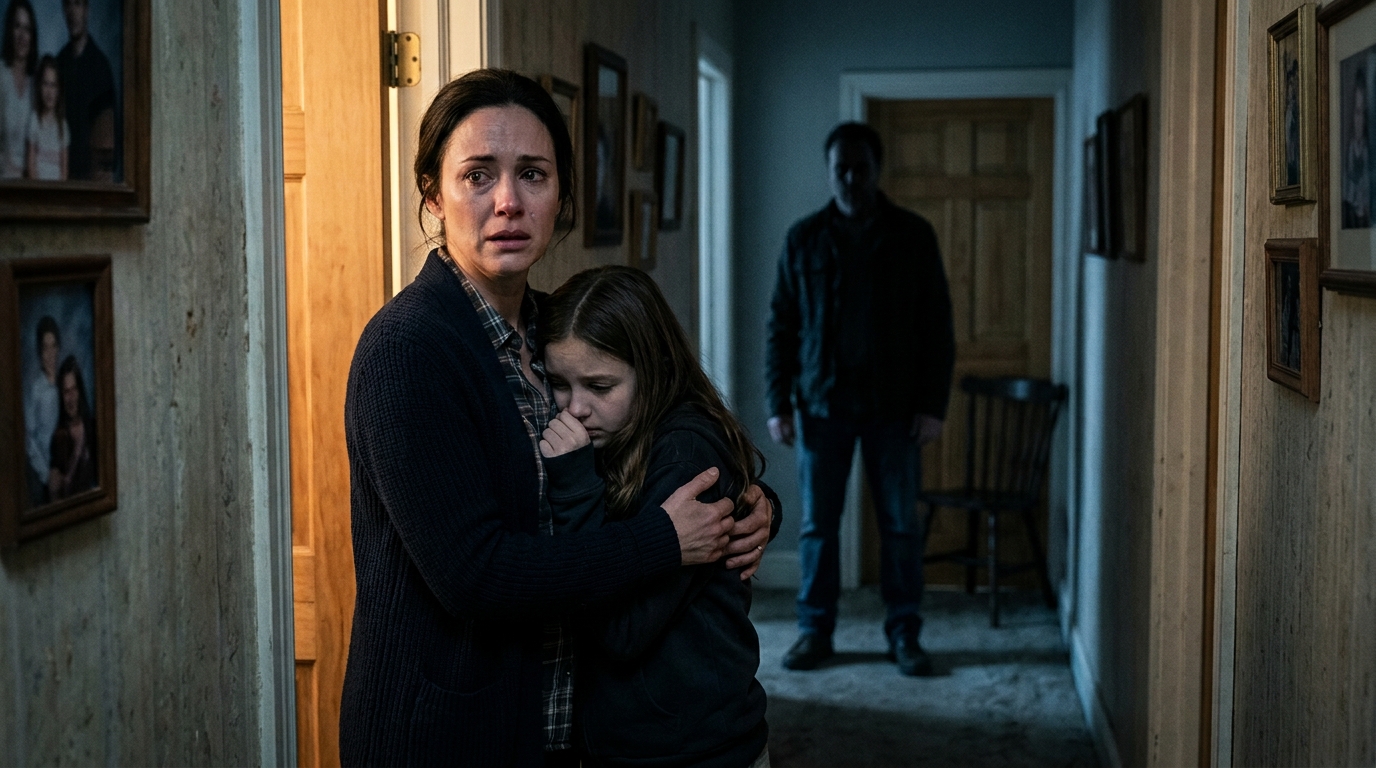
The first time my twelve-year-old daughter asked me not to leave her alone with her father, I thought she was angry with him.
Lily stood beside the front door with both hands wrapped around the straps of her schoolbag.
“Can I come with you?” she asked.
“I’m only going to the pharmacy.”
“I know.”
“I’ll be back in twenty minutes.”
She glanced toward the living room.
Her father, Mark, was watching television.
“Please, Mom.”
There was something unusual in her voice.
Not sadness.
Not frustration.
Fear.
But I did not understand it then.
“Your dad is home,” I said. “You’ll be fine.”
Her fingers tightened around the straps.
“I don’t want to stay.”
Mark turned down the television.
“What’s wrong now?” he asked.
Lily looked at the floor.
“Nothing.”
He smiled at me and shook his head.
“She’s been acting like this all week.”
I kissed Lily’s forehead.
“Finish your homework. I’ll bring you something from the store.”
When I returned, she was in her bedroom with the door locked.
At dinner, she barely spoke.
That night, I heard her crying.
When I asked what was wrong, she wiped her face and said she had a stomachache.
I believed her.
For the next month, Lily changed in ways I could not explain.
She stopped wearing the dresses she once loved.
She began sleeping with a chair pushed against her bedroom door.
She refused to sit beside Mark at the dinner table.
Whenever he entered a room, her shoulders became stiff.
At school, her grades dropped.
Her teacher called to say Lily had become quiet and easily startled.
I asked my daughter whether someone was bullying her.
“No.”
“Did something happen at school?”
“No.”
“Are you angry with me?”
She looked at me then.
Her eyes filled with tears.
“I tried to tell you.”
I felt a sudden chill.
“Tell me what?”
But before she answered, Mark walked into the kitchen.
Lily immediately lowered her eyes.
“What are you two talking about?” he asked.
“School,” I said.
He looked at Lily.
She stood so quickly that her chair scraped against the floor.
“I’m going upstairs.”
Mark watched her leave.
Then he sighed.
“You’re letting her become disrespectful.”
“She seems afraid of something.”
“She’s twelve. Everything is dramatic at that age.”
I wanted to believe him.
Mark had been my husband for fourteen years.
He was polite to neighbors, dependable at work, and always willing to help friends.
People often told me how lucky I was.
He never shouted in public.
He never lost control where others could see.
That made it easy to doubt what I was beginning to notice.
One evening, Lily refused to go on a family trip.
Mark had planned a weekend at a cabin outside the city.
“You used to love the lake,” I told her.
“I don’t want to go.”
“Why?”
“I just don’t.”
Her father appeared behind me.
“We’re not changing everyone’s plans because she’s in a mood.”
Lily’s face went pale.
“I’m staying with Grandma.”
“No, you’re not,” Mark said.
She looked at me.
“Mom, please.”
That word again.
Please.
I became irritated.
“Lily, enough. Go pack.”
She began to cry.
Mark rolled his eyes.
“She knows you always give in when she does this.”
Something in his tone made me uncomfortable.
He did not sound like a concerned father.
He sounded threatened.
That night, I opened Lily’s bedroom door without knocking.
She was sitting on the floor beside her bed, tearing pages from a notebook.
“What are you doing?”
She shoved the pages behind her.
“Nothing.”
I sat beside her.
“Why are you afraid of the trip?”
“I’m not.”
“You are.”
She stared at the carpet.
“Did your father hurt you?”
Her entire body became still.
It was the silence that answered me.
My heart began to pound.
“Lily.”
She covered her face.
“I told you I didn’t want to be alone with him.”
The room seemed to tilt.
I wanted to ask questions.
Too many questions.
When?
How?
Why did you not tell me?
But I remembered something her school counselor had once said at a parent meeting:
When a child reveals harm, the first response matters.
So I did not demand details.
I did not ask whether she was certain.
I did not tell her she must have misunderstood.
I moved closer and said the words she had needed to hear weeks earlier.
“I believe you.”
She began to shake.
Then she leaned into me and cried in a way I had never heard before.
Not loudly.
Almost silently.
As if she had learned that making noise was dangerous.
I held her carefully.
“You did nothing wrong,” I said.
She gripped my shirt.
“Are you angry with me?”
“No.”
“Are you going to tell Dad?”
“I’m going to keep you safe.”
She pulled away.
“He’ll say I’m lying.”
“I won’t.”
“He said you would choose him.”
Those words broke something inside me.
Not because I believed Mark.
Because for weeks, without knowing the truth, I had already been choosing his explanations over her fear.
I packed a small bag.
I called my sister and asked whether we could stay with her.
Then I contacted the authorities and a child-protection service.
When Mark realized we were leaving, he blocked the front door.
“What is going on?” he demanded.
“Move.”
“Where are you taking her?”
“Away from you.”
His expression changed.
For one second, I saw panic.
Then anger.
“What did she tell you?”
The question confirmed more than he understood.
I had not said Lily had told me anything.
He looked toward the staircase.
“She lies,” he said quickly. “You know how she is.”
I stepped between him and the stairs.
“Do not speak to her.”
“You’re destroying this family over a child’s imagination.”
“No,” I said. “Someone else did that.”
He moved toward me.
I raised my phone.
“The police are on their way.”
He stopped.
The confidence disappeared from his face.
Within minutes, our home filled with strangers.
Officers.
A social worker.
A woman who spoke softly to Lily and never pressured her to say more than she could.
Mark denied everything.
He said Lily was jealous.
He said she wanted attention.
He said I had influenced her.
He said our marriage had been difficult and I was using our daughter against him.
For several days, I barely slept.
Part of me wanted undeniable proof.
Not because I doubted Lily.
Because I could not understand how the man who made coffee for me every morning could also be the person she feared most.
Then investigators searched the house.
Behind a loose panel in Mark’s locked desk, they found a second phone.
It contained messages, hidden recordings, and evidence that showed Lily had not been the first child he had harmed.
There were names I recognized.
A former neighbor’s daughter.
The child of one of his friends.
A teenage babysitter who had suddenly stopped working for us years earlier.
The truth was larger than our family.
That was when I stopped asking how I had missed it.
And started asking how many people had seen pieces of it but explained them away.
The neighbor’s daughter had once refused to enter our house.
Her mother called her rude.
The babysitter quit without collecting her final payment.
Mark said she was irresponsible.
Lily had begged me not to leave her alone.
I called it a phase.
Every warning had been given another name.
Moodiness.
Disrespect.
Attention-seeking.
Teenage behavior.
Anything except fear.
Mark was arrested.
The investigation lasted months.
The court process lasted longer.
Lily had to repeat parts of her story to trained professionals.
Each time, I sat nearby.
I did not ask her to forgive me.
Not then.
An apology could not erase the moments when she had asked for safety and I had told her to finish her homework.
Instead, I showed her that I believed her.
I attended counseling with her.
I changed the locks.
I stopped sharing information about her with relatives who questioned her story.
When someone said, “But Mark always seemed so kind,” I answered:
“That is why appearances are not evidence.”
Some family members supported us.
Others did not.
Mark’s sister accused Lily of ruining his life.
My own aunt told me I should have handled the matter privately.
A family friend asked whether sending him to prison would really help anyone.
I learned that some people care more about preserving the image of a family than protecting the child inside it.
I ended those relationships.
The hardest conversation came nearly a year later.
Lily and I were sitting in the kitchen of our new apartment.
She had grown taller.
She laughed more often.
But she still checked that the front door was locked before going to bed.
“Mom?” she said.
“Yes?”
“Why didn’t you believe me the first time?”
There was no answer that could protect me from the truth.
“I did not understand what you were trying to say.”
“You knew I was scared.”
“Yes.”
“But you left anyway.”
I looked down.
“Yes.”
She waited.
I could have defended myself.
I could have said adults sometimes miss signs.
I could have said her father manipulated me.
Both were true.
Neither was enough.
“I failed you in that moment,” I said. “You asked me for safety, and I treated your fear like bad behavior.”
She began to cry.
So did I.
“I’m sorry,” I said. “You never should have had to ask twice.”
She did not forgive me immediately.
That was her right.
Healing is not a scene where someone apologizes and the pain disappears.
It is a long series of ordinary days in which safety must be proven again and again.
Two years after Mark’s arrest, Lily returned to music lessons.
She had stopped playing the piano during the worst months.
The sound had once filled our home.
Then silence had taken its place.
At her first recital, she walked onto the stage in a blue dress she had chosen herself.
For a moment, she stood beneath the lights with her hands trembling.
Then she looked toward me.
I smiled.
She sat at the piano and began to play.
The song was slow at first.
Then stronger.
By the final note, the entire room was silent.
Lily stood.
People applauded.
I did not cry because the performance was perfect.
I cried because she had taken back something fear had stolen from her.
Afterward, she handed me the program.
On the back, she had written one sentence:
You believe me now.
I held the paper against my chest.
“Yes,” I said. “Always.”
The shocking truth was not only that my husband had harmed our daughter.
It was that he had trusted everyone around him to doubt her before they doubted him.
For a while, he was right.
He understood how easily adults dismiss children when the truth threatens the life they want to believe they have.
He knew that a respectable face could outweigh a frightened voice.
He knew silence could be disguised as family loyalty.
But he did not understand one thing.
Once Lily knew she was believed, he lost the power that secrecy had given him.
Our family did not survive in the form I once imagined.
The house was sold.
The marriage ended.
People chose sides.
But my daughter survived.
And I learned that protecting a family does not mean keeping everyone together.
Sometimes, it means believing the smallest voice in the room—even when the truth tears everything else apart.