My grandfather called me “Rose” for the first time when I was nine years old.
We were sitting on the porch of his old farmhouse, shelling peas into a metal bowl while summer rain tapped against the roof.
I had just told him about a school play when he smiled at me and said, “You were always brave, Rose.”
I laughed.
“My name is Emily, Grandpa.”
His smile disappeared.
For a moment, he looked frightened.
Then he rubbed his forehead and said, “Of course it is.”
My mother told me not to worry.
“He’s getting older,” she said.
But my grandfather was only sixty-eight then. He still repaired fences, drove himself into town, and remembered the birthday of every relative in the family.
He forgot nothing.
Except, apparently, my name.
Over the next several years, it happened again.
Sometimes he called me Rose when I wore my hair tied back.
Sometimes when I played the piano.
Once, when I cried after breaking my arm, he held my hand and whispered, “I’m sorry I didn’t protect you, Rose.”
That sentence stayed with me.
Protect her from what?
Whenever I asked who Rose was, my grandfather became quiet.
“No one you need to know,” he would say.
My mother reacted differently.
She became angry.
“There has never been a Rose in this family.”
“But Grandpa keeps saying it.”
“He is confused.”
“He doesn’t seem confused.”
“Emily, stop asking.”
The sharpness in her voice made me stop.
But it did not make me forget.
My grandfather and I were close.
He taught me how to plant tomatoes, change a tire, and tell when a storm was coming by the smell of the air.
He was not an affectionate man with most people, but with me, he was gentle.
Every Sunday, he saved the corner piece of apple pie because he knew it was my favorite.
Every birthday, he gave me a book with a handwritten note inside.
And every few months, he looked at me as though I belonged to a memory he could not escape.
When I turned twenty-two, his health began to fail.
He stopped driving.
He forgot where he left his glasses.
He asked the same questions more than once.
That was when my mother finally had a reasonable explanation.
“Dementia,” she said.
The doctor agreed that his memory was declining.
But even as he forgot ordinary things, the name Rose became clearer.
One afternoon, I found him standing in front of an old family photograph in the hallway.
The picture showed my grandfather, my grandmother, my mother, and my uncle outside the farmhouse.
My mother was about twelve.
My uncle looked sixteen.
There was an empty space between them, as though someone had been standing there but moved away before the camera clicked.
Grandpa touched that empty space.
“She should have been there,” he said.
“Who?”
He looked at me.
“Rose.”
I felt a chill.
“Who was she?”
His eyes filled with tears.
“Your mother said never to tell you.”
Before I could ask more, my mother entered the room.
She took the photograph from the wall.
“That’s enough,” she said.
Grandpa lowered his head.
I followed my mother into the kitchen.
“What are you hiding?”
“Nothing.”
“He said you told him not to tell me.”
“He doesn’t know what he’s saying.”
“He knew exactly what he was saying.”
She placed the photograph inside a cabinet.
“You are upsetting him.”
“No. I’m asking a question.”
“And I’m telling you to leave it alone.”
“Why?”
“Because not every old story deserves to be brought back.”
That answer confirmed what I had suspected for years.
Rose was real.
And my family had agreed to erase her.
After that day, my mother stopped leaving me alone with Grandpa.
She attended every visit.
She answered questions for him.
She changed the subject whenever he spoke about the past.
The more she tried to control the conversation, the more determined I became to learn the truth.
Then, one night, my grandfather called me.
His voice was weak.
“Emily, come to the house.”
“Is something wrong?”
“I need to give you something.”
“What?”
“Before they find it.”
“Who?”
But the line went silent.
I drove to the farmhouse immediately.
My mother’s car was already outside.
When I entered, she was standing in the living room holding an old metal box.
Grandpa sat in his chair, breathing heavily.
“What is that?” I asked.
“Nothing important,” my mother said.
“Give it to her,” Grandpa whispered.
My mother’s face tightened.
“Dad, you’re tired.”
“Give it to her.”
“She does not need this.”
“It belongs to her.”
The room became still.
I looked at my mother.
“What belongs to me?”
She held the box against her chest.
Grandpa tried to stand, but his legs failed.
I rushed to help him.
He gripped my wrist.
“Rose did not leave,” he said.
My mother’s face turned pale.
“Dad, stop.”
“She was taken.”
My heart began to pound.
“Who was taken?”
He looked directly at me.
“You.”
My mother dropped the box.
The sound echoed through the room.
Before anyone could speak, Grandpa collapsed.
The ambulance arrived within minutes.
He suffered a severe stroke.
At the hospital, he never regained consciousness.
He died two days later.
My mother arranged the funeral quickly.
She avoided being alone with me.
Whenever I mentioned his final words, she said grief had confused him.
But grief did not explain the fear on her face.
After the burial, I returned to the farmhouse.
My mother had removed the metal box.
The old photograph was gone too.
I searched every room.
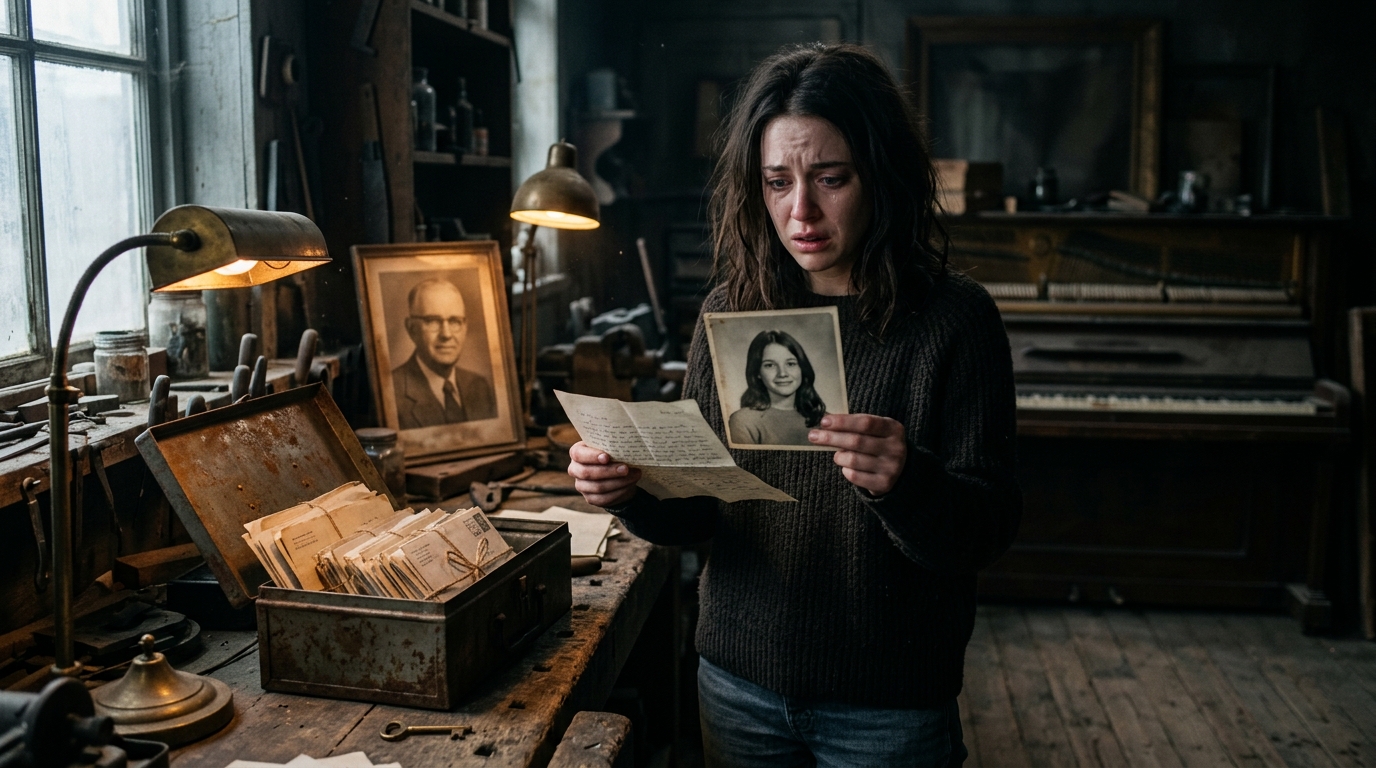
In Grandpa’s bedroom, I found a small brass key taped beneath a drawer.
It opened the filing cabinet in his workshop.
Inside were tax records, property documents, and old letters.
At the very back was an envelope with my name on it.
The handwriting was Grandpa’s.
Emily,
If you are reading this, I failed to tell you while I was alive. I hope you can forgive me.
My hands began to shake.
Your family has lied to you from the day you entered this house.
Inside the envelope was a photograph of a teenage girl.
She had dark hair, pale skin, and a small birthmark beneath her left eye.
I had the same birthmark.
On the back, Grandpa had written:
Rose, age seventeen.
I stared at her face.
She looked like me.
Not vaguely.
Not in the way relatives sometimes resemble each other.
She looked exactly like an older version of me.
The letter continued.
Rose was my eldest daughter. Your mother’s older sister.
I sat down on the workshop floor.
My mother had always told me she had only one brother.
There had never been any mention of a sister.
According to Grandpa’s letter, Rose had been the brightest of his children.
She played piano.
She wanted to become a teacher.
But when she was seventeen, she became pregnant.
The father was an older married man from town.
My grandmother believed the pregnancy would destroy the family’s reputation.
So they sent Rose to stay with relatives in another state.
They told neighbors she had gone to school.
They told her younger siblings not to speak about her.
Months later, Rose gave birth to a baby girl.
Me.
I stopped reading.
The paper trembled in my hands.
My mother was not my biological mother.
She was my aunt.
The woman I had been taught never existed had given birth to me.
I forced myself to continue.
Rose wanted to keep you. Your grandmother refused. She said no one would marry Rose if she returned with a child.
Your mother, Linda, was twenty-two and newly married. She had recently learned she could not have children. The family decided Linda would raise you as her own.
Rose was told it would be temporary.
It was not.
I felt sick.
Grandpa wrote that Rose returned to the farmhouse six months after my birth.
She demanded her daughter back.
My grandmother refused to let her inside.
My mother threatened to call the police.
They told Rose she had abandoned me.
They said a court would never return a baby to an unmarried mother without money or a home.
Rose screamed from the front yard until Grandpa came outside.
He promised her he would fix everything.
He never did.
That was the part of the letter where his handwriting became unsteady.
I told myself you were safe. I told myself Rose would rebuild her life. I told myself keeping peace was better than tearing the family apart.
Those were lies.
Rose left town.
For years, she wrote letters asking about me.
My grandmother destroyed most of them.
Grandpa secretly saved a few.
I found them inside the envelope.
The first was written when I was two.
Dad, please send me a photograph of her. I need to know if she still has the little mark beneath her eye.
Another came when I was five.
Tell Linda I do not want to take Emily away from the only home she knows. I only want her to know I exist.
Then one from my ninth birthday.
I sent a red coat. Did she receive it?
I remembered that coat.
My mother had told me it came from a department store.
There were birthday cards I had never seen.
Photographs.
School drawings Rose had somehow obtained.
She had been watching my life from a distance.
Then the letters stopped.
Grandpa explained why.
When I was twelve, Rose returned again.
This time she had a stable job and a small apartment.
She had hired a lawyer.
She intended to tell me the truth.
My mother found out.
The family arranged a meeting at the farmhouse.
An argument followed.
Rose drove away in a storm.
Her car was later found near a river.
The official report said she had lost control on a wet road.
She died before reaching the hospital.
The story felt horribly familiar.
A woman erased from a family.
A convenient accident.
A truth no one wanted examined.
At the bottom of the letter, Grandpa had written:
I believed the accident was my punishment for failing her. But years later, I learned it may not have been an accident.
There was a second envelope marked:
Evidence.
Inside were copies of police reports and an insurance document.
Rose’s brakes had failed.
The mechanic who examined the car noted that a brake line appeared damaged.
But the investigation ended quickly.
There was no proof of who had done it.
Then I found a handwritten statement from my uncle, David.
It was dated ten years after Rose’s death.
I saw Linda near Rose’s car before the meeting. She told me she was checking a flat tire. I believed her. After the crash, she made me promise never to mention it.
I could barely breathe.
My mother may have caused Rose’s death.
I called her.
She did not answer.
I drove to her house.
The metal box from Grandpa’s living room sat on her dining table.
My mother was packing a suitcase.
“Where are you going?” I asked.
She looked at the letter in my hand.
“So you found it.”
“Rose was my mother.”
Linda closed her eyes.
“Yes.”
The word changed my entire life.
“You lied to me.”
“I raised you.”
“That does not answer me.”
“I gave you everything.”
“You stole me from her.”
“She could not care for you.”
“She came back.”
“You do not understand what she was like.”
“What was she like?”
“Unstable. Impulsive. Selfish.”
I held up the letters.
“She spent years asking to see me.”
Linda’s expression hardened.
“Letters do not make someone a mother.”
“Neither does lying.”
She flinched.
I placed David’s statement on the table.
“Did you damage her brakes?”
Her face emptied.
For several seconds, she said nothing.
Then she sat down.
“I wanted to frighten her.”
The room seemed to disappear around us.
“What?”
“I thought if the brakes felt wrong, she would stop driving and miss the meeting with the lawyer.”
“You cut the brake line?”
“I loosened something. I did not know it would fail completely.”
“She died.”
“I know.”
“And you let everyone believe it was an accident.”
“I had you to think about.”
“No. You had yourself to protect.”
Tears filled her eyes.
“You were my daughter.”
“I was hers first.”
“She would have taken you.”
“She said she did not want to.”
“She changed her mind constantly.”
“You do not know that.”
“I knew her.”
“No,” I said. “You were afraid of her.”
Linda began crying.
“I could not lose you.”
The confession was not dramatic.
There was no shouting after that.
Only a woman sitting at a table, finally admitting that love had become possession.
She had wanted a child so desperately that she convinced herself every lie was protection.
First she helped take me.
Then she hid my mother.
Then she damaged a car to stop the truth from reaching me.
She called all of it love.
I called the police.
The case was reopened.
Because so many years had passed and the original evidence was limited, prosecutors warned that proving murder would be difficult.
But Linda admitted tampering with the car.
She was charged.
My uncle gave a statement.
The mechanic’s notes were recovered.
For the first time, Rose’s death was treated as more than bad weather and misfortune.
People in the family begged me not to proceed.
They said Linda was still my mother.
They said she had raised me.
They said exposing the truth would destroy what remained of the family.
But the family had already been destroyed.
The lies had only kept everyone pretending otherwise.
Months later, I visited Rose’s grave.
Her headstone listed her as a beloved daughter and sister.
It did not say mother.
I placed one of her letters beside the stone.
“I’m sorry,” I whispered.
I was sorry she had been erased.
Sorry she had spent years wondering whether I knew she existed.
Sorry that when Grandpa called me Rose, I had corrected him.
Now I understood.
He had not always confused us.
Sometimes he looked at my face and saw the daughter he had failed.
Before leaving, I arranged to have one word added beneath her name.
Mother.
My relationship with Linda did not survive.
I could not call her Mom after learning the truth.
But I could not erase the twenty-two years she had cared for me either.
That was the most painful lesson.
A person can love you and still build your life on a terrible lie.
Love does not automatically make someone honest.
Sacrifice does not erase harm.
And raising a child does not give anyone the right to steal her history.
The final surprise came six months after the case reopened.
A lawyer contacted me.
Rose had created a trust shortly before her death.
It contained no large fortune.
Only a small savings account, a piano, and a sealed letter.
The piano had been stored for twenty years.
Inside the letter, Rose wrote:
Dear Emily,
They may tell you I wanted to take you away. That is not true. I wanted to meet you once, and then let you decide when you were old enough.
I do not need you to call me Mother. I only need you to know that I never left you willingly.
If the truth reaches you someday, please do not let it make you bitter. A lie can shape your beginning without owning your future.
I read those lines at the piano she had left me.
Then I opened the bench.
Inside were sheets of music marked with notes in her handwriting.
One piece had a title:
For Emily, When She Comes Home.
I placed my hands on the keys.
The melody was simple.
I recognized it immediately.
It was the lullaby my mother had sung to me throughout childhood.
The song I thought belonged to Linda.
It had been written by Rose.
Even the most tender part of my childhood had carried a hidden truth.
My grandfather called me by another girl’s name for years.
I believed age had confused him.
But perhaps he had been trying, in the only broken way he could, to place Rose back inside the family.
Not as a shameful secret.
Not as a forgotten sister.
But as the mother whose love had survived every lie told about her.