For as long as I could remember, there had been one room in our house that my father never allowed me to enter.
It was at the end of the upstairs hallway, behind a heavy wooden door with a brass lock.
When I was little, I believed it was filled with old furniture.
When I was twelve, I became convinced he was hiding money.
By the time I turned twenty-four, I stopped asking.
My father, Thomas, was not a cruel man.
He was quiet, careful, and deeply private.
He raised me alone after my mother died when I was six. He packed my lunches, attended every school performance, and learned how to braid my hair by practicing on a length of rope.
But whenever I mentioned the locked room, his expression changed.
“Some doors should remain closed,” he would say.
It was the only answer he ever gave me.
I hated that answer.
Secrets have a way of growing larger than the truth.
The less my father told me, the more terrible my imagination became.
I wondered whether the room contained something connected to my mother.
Perhaps old letters.
Perhaps photographs.
Perhaps proof that the story I had been told about her death was incomplete.
According to my father, my mother, Eleanor, had died in a car accident during a storm.
There had been no other passengers.
No witnesses.
No final message.
Only a funeral I barely remembered and a father who never spoke her name unless I asked first.
Whenever I questioned him about her, he answered politely but briefly.
“She loved music.”
“She laughed loudly.”
“She was stubborn like you.”
Then he would change the subject.
As I grew older, I began to resent him for that silence.
He had memories of her.
I had only fragments.
One faded photograph on the mantel.
A silver necklace in my dresser.
A lullaby I could not fully remember.
The locked room became a symbol of everything he refused to share.
Then, one winter morning, my father collapsed in the kitchen.
The doctors found an aggressive cancer that had already spread.
They gave him months.
He lived for seven weeks.
During that time, I moved back into the house to care for him.
We spent long evenings in the living room, surrounded by medicine bottles and old movies neither of us watched closely.
I thought illness might make him more honest.
Instead, it made him quieter.
One night, while helping him upstairs, we stopped outside the locked room.
His hand tightened around the railing.
“Dad,” I said softly. “What is in there?”
He stared at the door.
For a moment, I thought he might finally tell me.
Then he looked away.
“Not yet.”
“When?”
He took a painful breath.
“When I’m gone.”
I felt anger rise inside me.
“You’re dying, and you still won’t trust me?”
“It isn’t about trust.”
“Then what is it about?”
“Protecting you.”
“I’m not a child.”
“I know.”
“Then stop treating me like one.”
He closed his eyes.
“I made a promise.”
“To whom?”
He did not answer.
That night, we barely spoke.
Three days later, he was admitted to the hospital.
He never came home.
Before he died, he asked me to open the drawer beside his bed.
Inside was a small brass key.
I recognized it immediately.
“The room?” I asked.
He nodded.
His voice was weak.
“Wait until after the funeral.”
“Why?”
“Because once you know, you cannot unknow it.”
I held the key tightly.
“Is it about Mom?”
A tear slipped down his cheek.
“Yes.”
“Did you lie to me?”
He looked at me for a long time.
Then he whispered, “I told you the version I could live with.”
Those were the last words he ever said to me.
My father died before sunrise.
The funeral was held five days later.
Neighbors filled the church.
People told me how kind he had been, how dependable, how proud he was of me.
I thanked them.
I smiled when necessary.
But all I could think about was the key in my coat pocket.
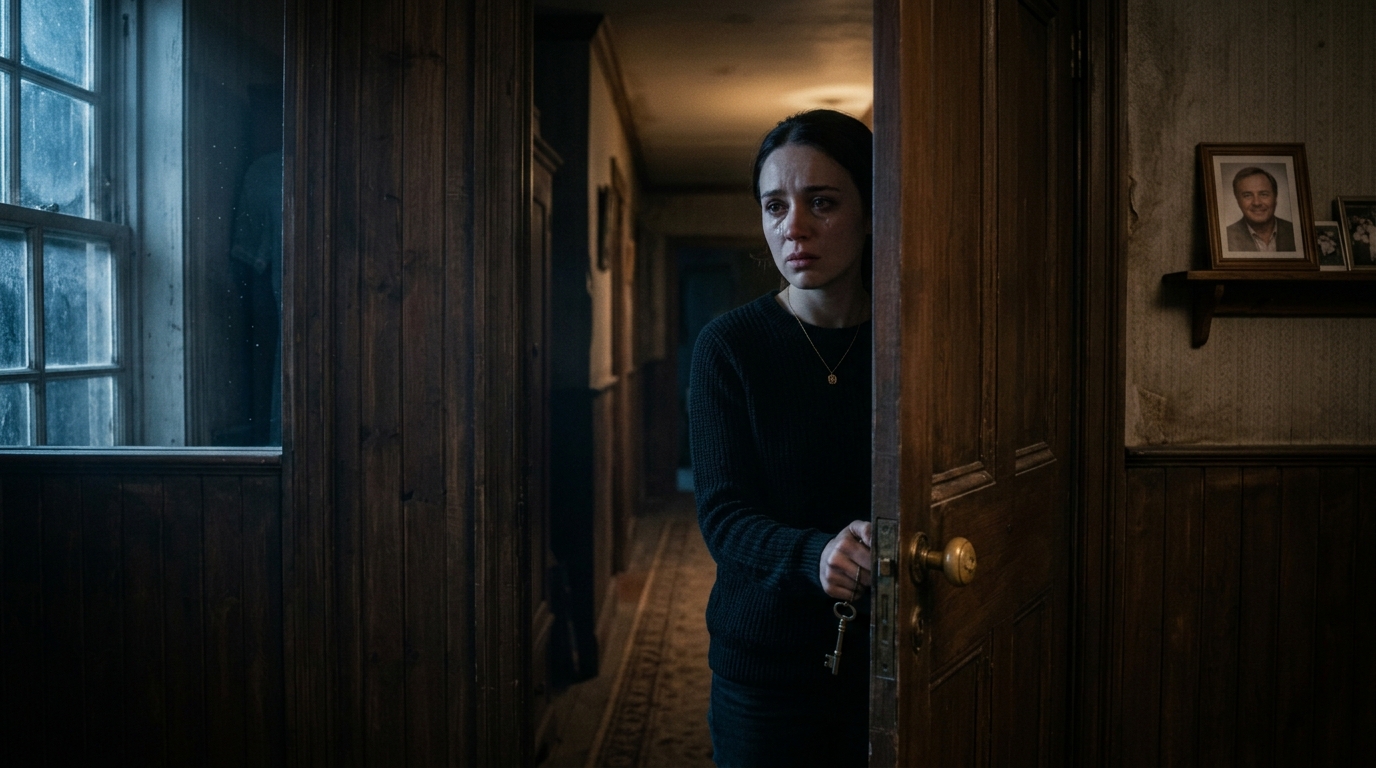
That evening, after everyone left, I stood alone at the end of the upstairs hallway.
The house felt different without him.
Larger.
Colder.
The brass key slid into the lock.
For a moment, it would not turn.
Then the mechanism clicked.
I opened the door.
The room smelled of dust, cedar, and something faintly floral.
There was no hidden fortune.
No frightening collection.
No obvious crime.
Instead, the room looked preserved.
A narrow bed stood beneath the window.
A blue dress hung from a wardrobe.
Books lined the walls.
On a small desk sat a record player, several handwritten notebooks, and dozens of unopened letters tied with ribbon.
The room had belonged to a woman.
At first, I assumed it was my mother’s.
Then I saw the photographs.
The woman in them looked almost exactly like her.
Same dark hair.
Same eyes.
Same smile.
But beneath one photograph, someone had written a name.
Margaret, 1989.
My mother’s name was Eleanor.
I searched through the drawers.
I found two birth certificates.
The first belonged to Eleanor Rose Bennett.
The second belonged to Margaret Rose Bennett.
Same date of birth.
Same parents.
Twins.
My mother had a twin sister.
A sister no one had ever mentioned.
I sat on the edge of the bed, trying to understand.
Why had my father hidden this?
Why had he preserved Margaret’s room?
Why had he never told me she existed?
I opened the first notebook.
It belonged to my mother.
The early pages described childhood.
Eleanor and Margaret had been identical twins, but their personalities were different.
My mother was outgoing and impulsive.
Margaret was quiet and cautious.
They dressed alike as children, switched places at school, and played tricks on relatives who could not tell them apart.
But as they grew older, their closeness changed.
Both sisters fell in love with the same man.
My father.
Thomas.
The entries became more painful.
My mother wrote that Margaret loved him first.
But Thomas chose Eleanor.
Margaret moved away soon after the wedding.
For years, the sisters barely spoke.
Then came the final entry.
Margaret called tonight. She says she needs help. Thomas does not know. I am going to meet her alone.
The date was the night my mother died.
My hands began to shake.
I opened the tied letters.
Most were written by Margaret to my father.
The first was dated two weeks after the accident.
Thomas,
I know you hate me. You should. Eleanor came because I asked her to. I should have been in that car, not her.
The next letter was worse.
You cannot keep telling Anna that I do not exist. She deserves to know she has family.
Anna was my name.
I read faster.
The letters continued for years.
Margaret begged my father to let her see me.
He refused.
She wrote about guilt.
About loneliness.
About the accident.
But one sentence appeared again and again.
You know I did not cause the crash.
That stopped me.
If Margaret had not caused it, why did my father blame her?
I searched the desk until I found an envelope marked:
For Anna, when Thomas is ready.
Inside was a letter from Margaret.
It had been written eight years earlier.
Dear Anna,
I have imagined meeting you thousands of times. In every version, you are angry with me. I do not blame you. Your father believes silence protected you, but silence also gave him control over the truth.
Your mother did not die because she came to rescue me. She died because she discovered something about Thomas.
I stopped reading.
The room seemed to narrow around me.
The letter continued.
The night of the accident, Eleanor told me she planned to leave him. She had found documents proving he had been using her identity to hide debt and property transfers. She was afraid he would take you away if she confronted him alone. She asked me to meet her.
Thomas followed her.
I could hear my own heartbeat.
There was an argument on the road. Eleanor drove away. Thomas followed in his car. I saw both vehicles disappear into the storm. Minutes later, Eleanor’s car went over the embankment.
Thomas told police he had been home all evening. I was too frightened to contradict him.
I stood so quickly that the chair fell behind me.
My father had been there.
He had lied about the accident.
But the letter did not accuse him of causing it.
It said only that he had followed her.
I kept reading.
I do not know whether Thomas forced her off the road. I only know he arrived at my apartment before the police did. His hands were bleeding. He told me that if I spoke, he would make sure I never saw you.
I was a coward.
I stayed silent.
At the bottom of the letter was an address.
I checked the date.
Eight years earlier.
Was Margaret still alive?
I called the number written beneath the address.
It was disconnected.
The next morning, I drove three hours to the small coastal town listed in the letter.
The house was empty.
A neighbor told me Margaret had died six years earlier.
“She was ill for a long time,” the woman said. “She lived alone.”
“Did she have any family?”
The neighbor studied my face.
Then her expression changed.
“You look like her.”
“I’m her niece.”
The woman hesitated.
“She used to say she had a daughter.”
I felt my stomach drop.
“A daughter?”
“She said the girl had been raised by someone else.”
“That must have been me. She probably meant niece.”
The neighbor shook her head.
“No. She said daughter.”
I drove home confused and frightened.
That night, I searched the locked room again.
Behind the wardrobe, I found a loose floorboard.
Beneath it was a metal box.
Inside were hospital records, legal documents, and a cassette tape.
The tape was labeled with my birthday.
I found an old player in the closet.
My father’s voice came through the speaker.
At first, he sounded younger.
Nervous.
Then another voice spoke.
A woman.
Margaret.
Their conversation had been recorded in a hospital room.
“You cannot do this,” Margaret said.
“I have no choice,” my father replied.
“She is my baby.”
“Eleanor believes she is hers.”
There was silence on the tape.
I stopped breathing.
Margaret began to cry.
“You said it would only be temporary.”
“It is better this way.”
“For whom?”
“For everyone.”
“No. It is better for you.”
The recording ended.
I replayed it three times.
Then I opened the hospital documents.
I was born at a private clinic two towns away from the hospital listed on my official birth certificate.
My mother’s name on the original record was Margaret Bennett.
Not Eleanor.
Margaret was not only my aunt.
She was my biological mother.
The truth unfolded slowly through the documents.
Margaret and my father had been involved before he married Eleanor.
Margaret became pregnant.
My father begged her to keep it secret.
At the same time, Eleanor suffered a late miscarriage that left her emotionally devastated.
The sisters had reconciled briefly.
Then my father proposed a plan.
Margaret would give birth privately.
Eleanor would raise the baby as her own.
My father convinced both women it would protect the family from scandal.
He told Margaret she could remain in my life as an aunt.
But after I was born, he cut her off.
Eleanor eventually discovered the truth.
Not only that I was Margaret’s daughter, but that my father had continued manipulating both sisters for years.
The night she died, Eleanor was planning to leave him and take me with her.
Margaret had asked her to come so they could expose him together.
My father followed.
But the documents still did not prove he caused the crash.
Then I found one final item in the metal box.
A police evidence bag.
Inside was a broken red taillight fragment.
My mother’s car had been blue.
My father’s car at the time had been red.
A note was attached in his handwriting.
I did not mean to touch her car.
I sat on the floor until sunrise.
My father had not simply followed Eleanor.
He had struck her vehicle during the chase.
Perhaps accidentally.
Perhaps in anger.
Either way, he had hidden the evidence.
He allowed the accident to be ruled the result of bad weather.
He raised me as a grieving widower.
He kept Margaret away because she knew the truth.
And when she died, he preserved her room like a shrine.
I did not know whether it was guilt or love.
Perhaps both.
I contacted the police.
The case was reopened.
My father was dead, so there would be no trial.
But investigators confirmed that the taillight fragment matched the model of car he owned at the time.
The old crash photographs showed damage to the rear side of Eleanor’s vehicle that had never been properly explained.
The official record was changed.
Her death was no longer listed as a single-car accident.
People asked whether knowing the truth gave me peace.
It did not.
Truth does not always free you.
Sometimes, it simply replaces one prison with another.
For months, I could not decide what to call the women in my life.
Eleanor had raised me.
She was the mother whose voice I remembered.
Margaret had given birth to me.
She was the mother whose existence had been erased.
And my father?
He had loved me.
I could not deny that.
He stayed awake when I was sick.
He worked two jobs to send me to college.
He saved every drawing I ever made.
But he had also built my entire life on a lie.
That was the hardest part to accept.
People are rarely only one thing.
A loving father can also be a frightened, selfish man.
A devoted parent can still destroy the people closest to him.
Years later, I returned to the house and opened the locked room one final time.
I placed photographs of both sisters on the desk.
Eleanor beside Margaret.
The mother who raised me beside the mother who lost me.
Then I found something I had missed before.
A small envelope taped beneath the desk drawer.
My name was written on it in my father’s handwriting.
Inside was a final note.
Anna,
I know what you will think of me when you find everything. Most of it will be true.
But there is one truth no document can show.
The night Eleanor died, she was not trying to take you away from me.
She was bringing you to Margaret.
I read the sentence again.
Then again.
At the bottom was a copy of a legal guardianship form.
Eleanor had signed it.
She intended to return me to Margaret.
My biological mother had not abandoned me.
She had been waiting for me.
My adoptive mother had not been running away with me.
She had been trying to reunite us.
And my father had not spent the rest of his life protecting me from a dangerous past.
He had been protecting himself from the moment I learned that both women had chosen me over him.
The locked room had never been meant to keep a secret hidden forever.
It was a confession he was too afraid to speak aloud.
I sold the house the following year.
Before leaving, I removed the lock from the upstairs door.
I could not change what had happened inside that family.
I could not ask the dead for answers.
But I could refuse to continue the silence.
Today, I keep photographs of both women in my home.
When people ask which one was my real mother, I tell them the truth.
One gave me life.
One gave me love.
Both tried to save me.
And the man who raised me spent decades making sure I never discovered that the greatest secret of his past was not how my mother died.
It was that, before she did, she was trying to bring me home.