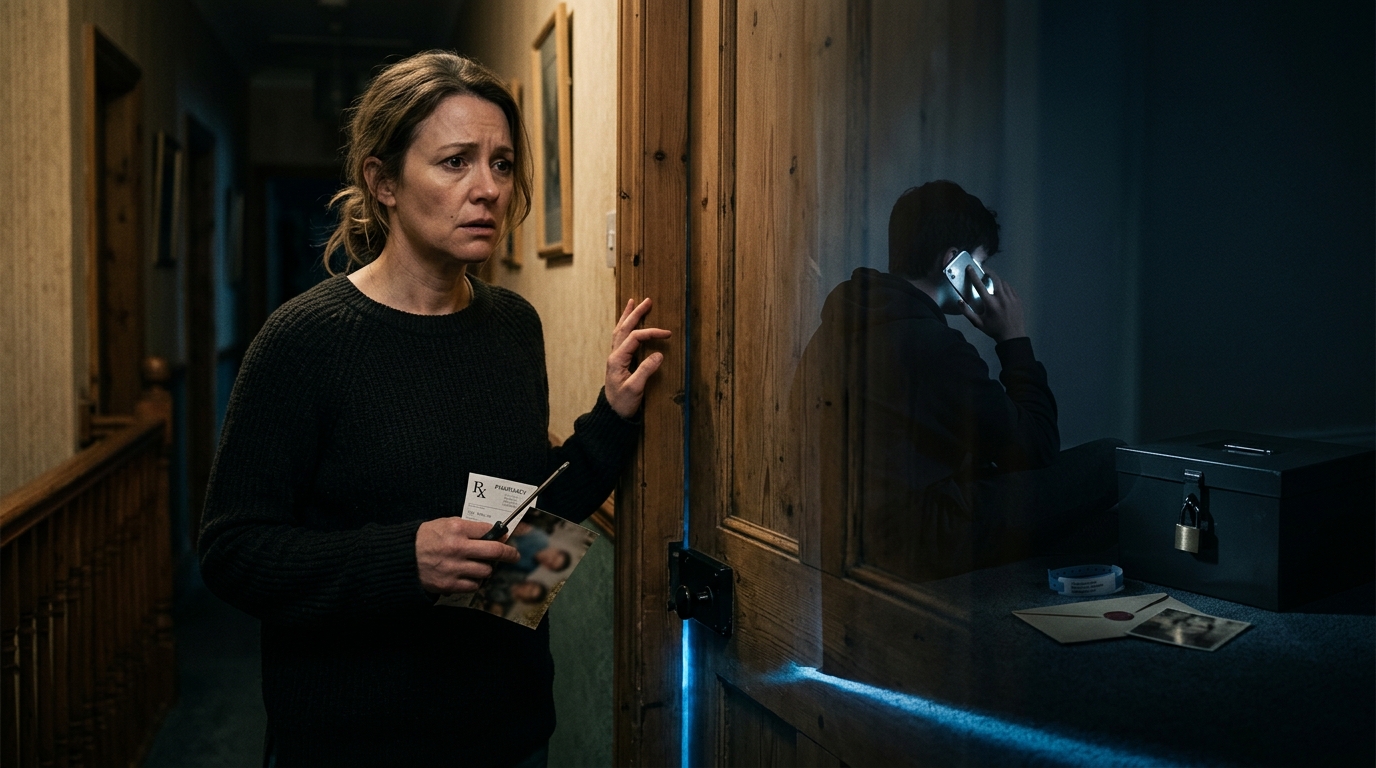
My son had never locked his bedroom door before.
Not when he was a little boy afraid of thunderstorms.
Not when he became a teenager and started asking for more privacy.
Not even after his father left us and silence became the third person living in our home.
But three months after his seventeenth birthday, Noah began locking it every night.
At first, I tried to respect his privacy.
He was growing up. I knew that.
Still, something about the change unsettled me.
He no longer came downstairs for dinner.
He stopped inviting friends over.
He hid his phone whenever I entered the room.
And every night, just after midnight, I heard strange sounds behind his locked door.
A chair scraping across the floor.
A drawer opening and closing.
Sometimes, a low voice speaking too softly for me to understand.
Whenever I knocked, everything became silent.
“Noah?”
“I’m sleeping.”
“You were talking.”
“No, I wasn’t.”
“Is someone in there?”
He would pause.
Then answer, “No.”
The first few times, I believed him.
By the tenth time, I no longer did.
Trust between a mother and son rarely breaks in one moment.
It weakens quietly.
One unanswered question at a time.
One lie that seems too small to confront.
One locked door where there had never been one before.
Noah had always been close to me.
After his father, Michael, left when Noah was twelve, my son became quieter but more protective.
He carried groceries without being asked.
He fixed things around the house.
Whenever I worked late, he stayed awake until he heard my key in the front door.
For years, it had felt as though the two of us were a team.
Then suddenly, I felt like a stranger standing outside his life.
The first real sign of trouble came when money disappeared from my bedroom drawer.
I kept emergency cash inside an old envelope beneath my scarves.
There had been six hundred dollars.
When I checked one afternoon, half was gone.
Noah was the only other person in the house.
I waited until dinner.
He sat across from me, pushing rice around his plate.
“Did you take money from my room?” I asked.
His hand stopped.
“No.”
“Three hundred dollars is missing.”
“I didn’t take it.”
“You’re sure?”
He looked at me then.
There was something in his eyes I did not recognize.
Not guilt exactly.
Something harder.
“Why would I steal from you?”
“I didn’t say you stole.”
“You didn’t have to.”
He stood so quickly that the chair struck the wall.
“Noah—”
But he had already walked upstairs.
Seconds later, I heard his bedroom door lock.
That sound felt like an answer.
Over the next several weeks, more things changed.
Noah started missing school.
His grades dropped.
He stopped playing basketball, even though he had loved the game since childhood.
A teacher called to tell me he had fallen asleep in class twice.
When I confronted him, he shrugged.
“I’m tired.”
“Why?”
“I can’t sleep.”
“What are you doing all night?”
“Nothing.”
“Then unlock your door.”
His face tightened.
“No.”
“I’m your mother.”
“And it’s my room.”
“It’s my house.”
The moment the words left my mouth, I regretted them.
Noah looked wounded.
Then angry.
“So that’s what this is?”
“What?”
“Your house. Your money. Your rules.”
“That’s not what I meant.”
“It’s exactly what you meant.”
He walked away before I could stop him.
I stood alone in the hallway, wondering how we had become two people who heard accusation in every sentence.
A few days later, I found a receipt in the pocket of Noah’s jacket.
It was from a pharmacy across town.
The items listed were hidden behind medical codes I did not understand.
The total was nearly two hundred dollars.
My fear became something darker.
Was he using drugs?
Was someone blackmailing him?
Was he sick?
That evening, I placed the receipt on the kitchen table.
“What is this?”
Noah’s face went pale.
“Where did you get that?”
“It was in your jacket.”
“You went through my things?”
“I was doing laundry.”
“You had no right to read it.”
“You are missing school, taking money, hiding things, and locking me out. I have every right to ask.”
He grabbed the receipt.
“It’s not what you think.”
“Then tell me what it is.”
“I can’t.”
“Why not?”
“Because you wouldn’t understand.”
I felt my patience break.
“Try me.”
He looked as though he wanted to speak.
For one second, I thought he would.
Then he folded the receipt and pushed it into his pocket.
“I said I can’t.”
That night, I called his father.
Michael and I had barely spoken in five years.
He had moved to another state after our divorce and had become the kind of parent who sent birthday messages but rarely appeared in person.
When he answered, his voice sounded surprised.
“Is Noah okay?”
“I don’t know.”
I told him everything.
The locked door.
The missing money.
The late-night voices.
The pharmacy receipt.
Michael listened without interrupting.
Then he said something that made my stomach turn.
“Maybe you should search his room.”
“I don’t want to betray him.”
“If he’s in danger, privacy comes second.”
I hated that he was right.
Two nights later, Noah came home after midnight.
I had been waiting in the living room.
“Where were you?”
“Out.”
“With whom?”
“Friends.”
“Which friends?”
“You don’t know them.”
He moved toward the stairs.
I noticed a dark stain on the sleeve of his sweatshirt.
“Is that blood?”
He pulled his arm away.
“It’s nothing.”
“Noah, stop.”
He stopped, but he did not turn around.
“Please,” I said. “Whatever this is, let me help you.”
His shoulders rose and fell.
Then he whispered, “You can’t.”
“Why?”
“Because this started with you.”
Before I could ask what he meant, he went upstairs and locked the door.
I did not sleep.
His words repeated in my mind.
This started with you.
By morning, I had convinced myself of a dozen terrible possibilities.
Maybe he blamed me for the divorce.
Maybe he had learned something about his father.
Maybe the money was connected to a mistake I had made.
I waited until he left for school.
Then I stood outside his bedroom.
The door was locked.
I held a small screwdriver in my hand.
For several minutes, I did nothing.
Then I removed the lock.
The room looked almost normal.
His bed was unmade.
Clothes were scattered across the floor.
Books and school papers covered the desk.
But the closet door was closed.
A chair had been pushed beneath the handle.
I moved it aside.
Inside the closet, behind a row of hanging shirts, was a large plastic storage box.
It had a padlock.
My hands shook as I forced it open.
Inside were dozens of envelopes.
Each one had a date written on the front.
There were also medical supplies, prescription bottles, stacks of printed emails, and photographs.
The first photograph showed Noah with a young girl I had never seen before.
She looked about fifteen.
She was thin, pale, and wearing a knitted cap over her head.
In the second photograph, they were sitting in a hospital corridor.
In the third, Noah was holding her hand beside a bed.
I opened one of the envelopes.
Inside was cash.
Nearly two thousand dollars.
The next envelope contained more.
Some had receipts.
Others held handwritten notes.
At the bottom of the box, I found a document with Michael’s name on it.
My former husband.
The heading read:
PATERNITY TEST RESULTS
I sat down on the floor.
The room seemed to tilt.
The test showed a 99.9 percent probability that Michael was the biological father of the girl in the photographs.
Her name was Sophie.
My ex-husband had another child.
Noah had a sister.
And somehow, he had known while I had not.
Beneath the test results was a letter addressed to Noah.
I should not have read it.
But by then, I had already crossed every boundary I once believed I would never cross.
The letter was from Sophie.
She wrote that she had learned about Noah through their father.
She had been diagnosed with leukemia.
Her mother had died years earlier.
Michael had recently disappeared from her life after promising to help with treatment costs.
Sophie had contacted Noah because she had no one else.
The pharmacy receipts were for her medication.
The cash was for medical bills.
The blood on Noah’s sleeve had come from the hospital after Sophie became ill during a visit.
The late-night voice was hers.
They had been speaking through video calls.
Noah had taken money from me.
But not for drugs.
Not for himself.
He had been helping his sick sister.
My anger collapsed beneath the weight of shame.
Then I heard the front door open.
“Noah?” I called.
Footsteps rushed up the stairs.
He stopped in the doorway when he saw the broken lock and the open box.
His face changed.
First shock.
Then betrayal.
Then something even worse.
Disappointment.
“You searched my room.”
“I was scared.”
“You promised you would never do that.”
“I thought you were in danger.”
“So you decided I didn’t deserve privacy?”
“Noah, I know about Sophie.”
He went still.
For a long moment, neither of us spoke.
Then he walked to the box and began placing everything back inside.
“Why didn’t you tell me?” I asked.
“Because I knew this would happen.”
“What would happen?”
“You’d make it about Dad.”
“He lied to both of us.”
“This isn’t about him.”
“He had another child.”
“She is my sister.”
“And you stole from me to help her.”
Noah turned around sharply.
“I borrowed money.”
“You lied.”
“So did you.”
The words struck me.
“What are you talking about?”
“You told me Dad left because he didn’t want a family.”
“That was true.”
“No, it wasn’t.”
He pulled a folded letter from beneath the papers.
“This is from him.”
I stared at it.
Noah continued.
“He said you knew about Sophie.”
I felt all the air leave the room.
“That’s not possible.”
“He said you found out years ago.”
“I didn’t.”
“He said that’s why you divorced him.”
“Noah, listen to me—”
“He said you made him choose.”
“I never knew about her.”
“He said you did.”
The pain in his face was worse than anger.
For weeks, he had not only been hiding Sophie.
He had been deciding which parent had lied to him.
“I wanted to ask you,” he said. “But every time I tried, I kept thinking you’d lie again.”
“I am not lying.”
“How am I supposed to know?”
That question broke me.
Because I had asked myself the same thing about him.
Trust had disappeared between us, and now neither of us knew where the first lie had begun.
I asked to see Michael’s letter.
It claimed that Sophie had been born during our marriage.
It claimed I had discovered the affair.
It claimed I had demanded that Michael abandon the child or lose Noah.
Every sentence was written to make me look cruel.
But one detail was wrong.
The letter said I had confronted Michael at a restaurant called Bellini’s on May 14.
On that date, I had been in the hospital after emergency surgery.
Michael had been beside me.
There were records.
Visitors.
Photographs.
The meeting could not have happened.
“This letter is false,” I said.
Noah looked uncertain.
“You would say that.”
“I can prove it.”
We went through an old box of documents in the basement.
I found the hospital discharge papers.
May 12 through May 16.
I found a photograph of Michael sleeping in the chair beside my bed.
The date was printed on the back.
May 14.
Noah read the papers twice.
“Then why would he write this?”
I already knew the answer.
Because Michael had lied.
Again.
But this time, the lie was larger than I understood.
We called him together.
At first, he denied everything.
Then Noah mentioned the impossible date.
There was silence.
Finally, Michael spoke.
“I didn’t know how else to explain it.”
“Explain what?” Noah demanded.
“That I failed both of you.”
His voice sounded smaller than I remembered.
Michael admitted that he had known about Sophie since she was a baby.
He had secretly sent money for years.
When our finances became difficult, he stopped.
Sophie’s mother threatened to tell me.
Instead of confessing, Michael left.
He had told me he no longer loved me.
He had told Noah that family life made him feel trapped.
Both were lies.
The truth was that he was running from responsibility.
Years later, when Sophie became sick, she contacted him.
He introduced her to Noah but begged him not to tell me.
Then, when medical bills increased, Michael disappeared again.
“Why did you send Noah that letter?” I asked.
“I panicked.”
“So you blamed me?”
“I thought if he believed you already knew, he wouldn’t hate me as much.”
Noah began to cry.
Not loudly.
That made it worse.
“You let me think Mom abandoned Sophie.”
“I’m sorry.”
“You let me steal from her.”
“I said I’m sorry.”
“No,” Noah said. “You’re sorry we found out.”
Then he ended the call.
For several minutes, we sat in silence.
I wanted to reach for him.
But I did not know whether I still had the right.
Finally, Noah said, “I should have told you.”
“Yes.”
“You should not have searched my room.”
“You’re right.”
“I did take the money.”
“I know.”
“I was going to pay it back.”
“I believe you.”
He looked at me.
It was the first moment in weeks that belief entered the room.
Then his phone rang.
It was the hospital.
Sophie had taken a sudden turn for the worse.
We drove there together.
I had never met her before.
Yet when I saw her lying in the hospital bed, I recognized Michael’s eyes.
And Noah’s smile.
She looked at me nervously.
“You’re his mom?”
“Yes.”
“I’m sorry.”
“For what?”
“For causing trouble.”
I sat beside her.
“You did not cause this.”
She looked toward Noah.
“He said you would be angry.”
“I was afraid,” I said. “That is not the same thing.”
Noah lowered his eyes.
Sophie reached for my hand.
Her fingers were cold.
“I didn’t want money,” she whispered. “I just wanted a family.”
That sentence stayed with me.
Over the following weeks, I remained at the hospital almost every day.
I spoke with doctors.
I worked with social services.
I contacted charities and community organizations.
Noah returned the money he had taken, but I placed it back in the hospital fund.
Slowly, our trust began to return.
Not because we forgot what had happened.
Because we stopped hiding from it.
Noah told me when he was afraid.
I admitted when I felt hurt.
We made one promise:
No more secret sacrifices.
No more protecting each other through lies.
Then came the result of Sophie’s final compatibility test.
Noah had already been tested as a potential bone marrow donor.
He was not a match.
Michael refused to come.
The doctors asked whether there were any other biological relatives.
I said no.
At least, that was what I believed.
Two days later, a hospital administrator called me into a private office.
She placed a file on the desk.
“There may be another possibility,” she said.
“What possibility?”
She hesitated.
“When Sophie’s records were reviewed, we found a discrepancy in the original paternity documentation.”
My heart began to pound.
“What does that mean?”
“The test you found was not conducted through this hospital. We repeated the test using verified samples.”
I stared at her.
“And?”
“Michael is not Sophie’s biological father.”
I felt confused.
“That’s impossible.”
“The new test excludes him.”
“Then why does she look like him?”
The administrator turned the file toward me.
“There was another genetic match in the family database.”
I looked down.
The name on the page was mine.
For several seconds, I could not understand what I was reading.
Then the room blurred.
Sophie was not Michael’s daughter.
She was mine.
The truth came back in fragments.
Eighteen years earlier, before Noah was born, I had delivered a baby girl prematurely.
The hospital told me she had died within hours.
I had never seen her body.
I had been sedated.
Michael had handled the arrangements.
I spent years believing I had buried a child I had never held.
But there had been no burial.
Michael confessed after the police became involved.
Our daughter had survived.
She needed expensive long-term medical care.
Michael, terrified and deeply in debt, had allowed a private adoption to proceed without my informed consent.
He told me she had died.
Years later, when he found Sophie again, he created the story about an affair because the real truth was far worse.
He had not abandoned another woman’s child.
He had given away mine.
Noah’s locked bedroom had not been hiding a stranger.
It had been hiding the sister I had mourned for eighteen years.
The daughter I thought I had lost.
The daughter who had spent her life believing she had no mother.
Sophie received treatment with help from a donor located through the national registry.
Her recovery was slow, but she survived.
The first time she came home with us, she stood outside Noah’s bedroom.
“So this is where you hid me?” she asked.
Noah smiled.
“I was trying to protect you.”
She looked at me.
“Did it work?”
I thought about the broken lock.
The stolen money.
The false letters.
The years of lies.
“No,” I said. “But the truth found us anyway.”
Today, Noah no longer locks his door.
Not because I asked him to stop.
Because he no longer has to hide a secret too heavy for him to carry alone.
Trust between us did not return exactly as it had been.
It became something stronger.
Before, we trusted because we assumed the other person would never lie.
Now, we trust because we know the truth can be painful—and we choose to face it together.
I once believed the worst discovery behind that locked door would be proof that my son had become someone I did not know.
Instead, I discovered that he had been protecting someone who belonged to both of us.
And the greatest shock was not that my son had hidden the truth.
It was that, without knowing it, he had brought my lost daughter home.