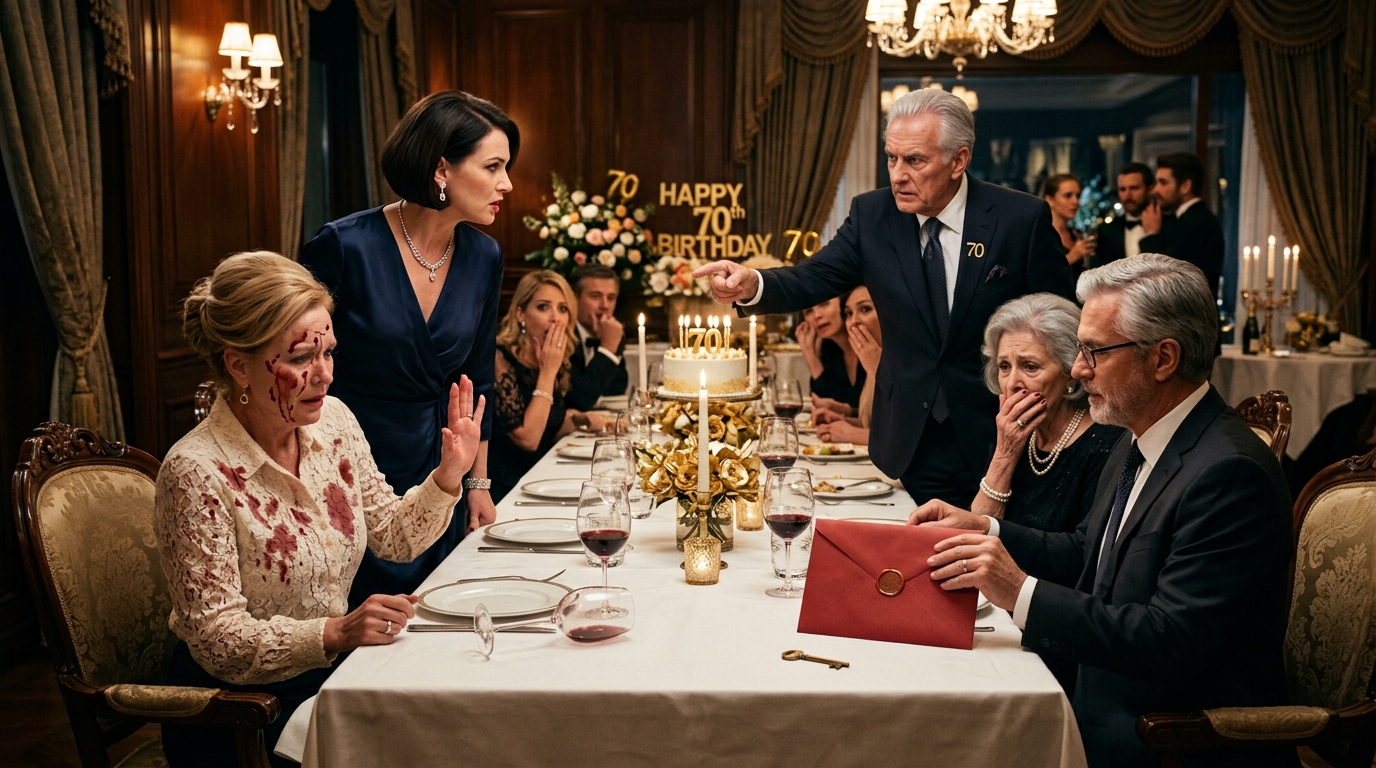
The glass hit the table before I understood what was happening.
Red wine splashed across my face, soaked the front of my cream blouse, and dripped from my hair onto the white tablecloth.
Around us, thirty guests fell silent.
My younger sister, Vanessa, stood on the other side of the table with the empty glass still in her hand.
“You thought you could steal everything and smile in front of us?” she shouted.
My mother gasped.
My uncle dropped his fork.
At the head of the table, my father, Richard, stared at Vanessa without saying a word.
It was his seventieth birthday.
We had rented the private dining room of an expensive restaurant, decorated it with gold flowers, and invited almost every relative we had.
The evening was supposed to honor him.
Instead, my sister had just accused me of stealing from him in front of everyone.
I wiped the wine from my eyes with a napkin.
“What are you talking about?”
Vanessa laughed bitterly.
“Don’t pretend you don’t know.”
Her husband, Eric, leaned back in his chair with a satisfied expression.
My mother looked between us.
“Vanessa, sit down.”
“No,” she said. “She has controlled this family long enough.”
I had no idea what she meant.
For most of our lives, Vanessa had been the favorite.
She was charming, beautiful, and capable of turning any mistake into someone else’s fault.
When she forgot birthdays, people called her busy.
When she borrowed money and failed to return it, they said she was struggling.
When she disappeared for months and returned needing help, my parents opened the door before she knocked.
I was the dependable daughter.
I handled appointments, bills, repairs, and emergencies.
After my father’s heart surgery, I stayed with him for six weeks.
When my mother broke her hip, I rearranged my work schedule to drive her to therapy.
Vanessa visited twice.
Each time, she took photographs, posted them online, and left before dinner.
Still, I never complained.
At least, not aloud.
My father had always told me, “Family is not a competition.”
I believed him.
That night, I learned Vanessa never had.
She reached into her handbag and pulled out several papers.
“I found these in Dad’s office.”
My father’s expression changed.
“You went into my office?”
“That’s not the point.”
“It is one of them,” he said.
Vanessa ignored him and held the papers toward the guests.
“Dad transferred the lake house into Laura’s name.”
Every face turned toward me.
My stomach tightened.
I looked at my father.
“Is that true?”
He did not answer immediately.
The lake house had belonged to my grandparents.
My sister and I had spent every summer there as children.
We learned to swim from the old wooden dock. We slept in the attic during storms and told each other ghost stories beneath heavy quilts.
After our grandmother died, the house went to our father.
For years, Vanessa talked about renovating it into a vacation rental.
I wanted to preserve it.
But no one had ever told me it had been transferred to my name.
Vanessa slapped the documents onto the table.
“She knew.”
“I didn’t.”
“Of course you did.”
“I’m hearing this for the first time.”
Eric shook his head.
“You expect us to believe that?”
I turned toward him.
“This is between my sister and me.”
“No,” Vanessa said. “This concerns the whole family.”
My father finally spoke.
“The lake house is mine. I can decide what happens to it.”
“You promised it would belong to both of us.”
“I never made that promise.”
“You said it would stay in the family.”
“And it will.”
Vanessa pointed at me.
“She is not the whole family.”
I could feel wine cooling against my skin.
The humiliation was bad enough.
But beneath it, something else was growing.
Confusion.
Why had my father transferred the house without telling me?
And why did Vanessa have legal documents from his office?
My mother reached for her hand.
“Please sit down. We can discuss this privately.”
Vanessa pulled away.
“No more private discussions. That is how Laura gets everything.”
“What have I gotten?” I asked.
“Dad’s trust. Mom’s dependence. Control of the accounts.”
“I help them because you refuse to.”
“I have children.”
“So do I.”
“That’s different.”
“How?”
“You always want to be the hero.”
The accusation surprised me.
For years, I had covered for her.
When she borrowed twenty thousand dollars from our parents to open a boutique and closed it eight months later, I never mentioned the money.
When she missed our father’s surgery because she was on vacation, I told him her flight had been canceled.
When she left our mother alone in the emergency room to attend a party, I stayed and said traffic had delayed her.
I had protected Vanessa so often that perhaps she had begun to believe I was doing it to make myself look better.
“You don’t know what you’re talking about,” I said.
“Oh, I know more than you think.”
She pulled another document from her bag.
“This is Dad’s updated will.”
The room became even quieter.
My father stood.
“Put that down.”
Vanessa looked almost triumphant.
“She gets the house, control of the trust, and half of everything else.”
“I did not give you permission to read that,” he said.
“You gave her permission to take our inheritance.”
“I have not taken anything,” I said.
Vanessa turned to the guests.
“Do you see how calm she is? She has already won.”
My face burned.
Not from the wine.
From the way people were looking at me.
Some were uncomfortable.
Others were curious.
A few seemed to believe her.
That hurt more than I expected.
My cousin Daniel avoided my eyes.
My aunt whispered something to her husband.
In one reckless moment, Vanessa had turned years of care into evidence of manipulation.
My father walked around the table.
“Leave,” he told her.
Vanessa stared at him.
“You’re throwing me out?”
“Yes.”
“On your birthday?”
“You entered my office, took private documents, and attacked your sister.”
“I exposed her.”
“You exposed yourself.”
Eric stood.
“You should be careful how you speak to my wife.”
My father looked at him coldly.
“And you should be careful what you encourage her to do.”
Eric’s confidence faded slightly.
Vanessa began to cry.
It happened so quickly that I almost admired it.
One moment she was furious.
The next, she was the injured daughter.
“I knew you loved her more.”
My father’s face softened, but only for a second.
“This is not about love.”
“It always is.”
“You want the house,” he said. “Not because you love it. Because you already promised it to someone else.”
Vanessa stopped crying.
I looked at my father.
“What does that mean?”
He returned to his chair and sat down slowly.
“You should ask her.”
Everyone turned toward Vanessa.
She opened her mouth, but Eric answered first.
“We had an opportunity.”
My father gave a humorless laugh.
“There it is.”
Vanessa glared at her husband.
“Be quiet.”
“No,” my father said. “Let him explain.”
Eric straightened his jacket.
“A development company contacted us. They are interested in the land around the lake. The house is old. The property is worth far more if it is divided.”
I stared at him.
“You planned to sell it?”
“It would be a smart financial decision.”
“It wasn’t yours.”
“It would have been partly Vanessa’s.”
My father leaned back.
“That is why you pressured me to sign those documents last winter.”
Vanessa’s face paled.
My mother looked confused.
“What documents?”
My father did not take his eyes off my sister.
“She brought papers to the hospital after my second procedure. She said they were insurance forms.”
The words landed heavily.
I remembered that day.
My father had been weak from medication.
Vanessa arrived carrying flowers and stayed alone with him for nearly an hour.
She later told us he had been sleeping.
“What were the papers?” I asked.
“A power of attorney and a preliminary property agreement,” my father said.
My mother covered her mouth.
Vanessa shook her head.
“That is not what happened.”
“The lawyer reviewed them.”
“You misunderstood.”
“I was sedated, Vanessa. I was not unconscious.”
She looked around the room, searching for support.
“This is ridiculous.”
“Is it?” my father asked.
“I was trying to help.”
“By obtaining authority over my property?”
“You said you wanted the family protected.”
“I wanted my medical bills organized.”
Eric stepped forward.
“The documents were never used.”
“Because my lawyer stopped you,” my father replied.
My pulse quickened.
I turned toward my sister.
“Did you really try to make Dad sign away control of the lake house?”
Her eyes narrowed.
“You don’t get to judge me.”
“That is not a denial.”
“You have no idea how much pressure I’m under.”
There it was.
The explanation that always appeared after the damage.
Pressure.
Bad timing.
Misunderstanding.
Someone else’s fault.
“How much money do you owe?” my father asked.
Vanessa froze.
My mother whispered her name.
Eric looked toward the door.
My father continued.
“The development company advanced you money, didn’t they?”
No one moved.
“How much?” I asked.
Vanessa’s lips trembled.
“Two hundred thousand.”
A shocked murmur moved around the table.
My mother gripped the edge of her chair.
“Two hundred thousand dollars?”
“It was an investment,” Eric said quickly.
“In property you did not own?” I asked.
He did not answer.
Vanessa sank into her chair.
Her anger was disappearing.
In its place was fear.
“We thought Dad would agree,” she said.
“You accepted money before asking him?” I said.
“The company wanted exclusivity.”
“You gambled with his home.”
“It’s an old house!”
“It belonged to our grandparents.”
“It is rotting.”
“It is still not yours.”
She slammed her palm against the table.
“You don’t understand! We were going to lose everything.”
My father’s voice became quieter.
“What did you lose?”
Vanessa looked at Eric.
He looked away.
She began crying again, but this time it did not feel rehearsed.
Eric’s construction business had failed.
They had borrowed against their home.
They owed suppliers, banks, and private lenders.
The boutique debt had never been repaid.
They had hidden everything for almost three years.
The lake property was supposed to save them.
They believed my father would eventually divide it between us.
Eric negotiated a deal before they had legal ownership.
When my father refused, they tried to gain control through the papers at the hospital.
When that failed, Vanessa searched his office and discovered the new transfer.
Then she decided the only way to stop it was to shame me publicly.
I looked around the table.
A few minutes earlier, I had been the suspected thief.
Now everyone understood who had actually been trying to take something.
But I did not feel victorious.
I felt tired.
My sister looked smaller than I had ever seen her.
My mother cried silently.
My father appeared ten years older.
I picked up a clean napkin and pressed it against my blouse.
“Why didn’t you ask for help?” I said.
Vanessa laughed through her tears.
“From you?”
“Yes.”
“So you could rescue me again?”
“I have never wanted you to fail.”
“No. You just wanted everyone to see that you never do.”
The words stung because part of them touched a truth I did not like.
I had helped her.
But I had also hidden her mistakes.
Each time I protected her from consequences, I made it easier for her to continue.
I thought I was preserving the family.
Perhaps I had only been preserving the pattern.
My father turned toward the gray-haired man seated near the end of the table.
Until then, he had barely spoken.
His name was Mr. Harris.
I knew him as my father’s longtime friend.
Vanessa knew him too.
What she did not know was that he was also my father’s estate lawyer.
“Please open the red envelope,” my father said.
Mr. Harris placed his briefcase on the table.
Vanessa looked alarmed.
“What envelope?”
He removed a thick red envelope sealed with wax.
My father nodded toward me.
“This is why I asked Laura to sit beside me tonight.”
I stared at him.
“You planned this?”
“Not the wine.”
For the first time that evening, someone almost laughed.
Mr. Harris broke the seal.
Inside was a document, a letter, and a small brass key.
He began reading.
The lake house had indeed been transferred into my name.
But not as a private gift.
My father had created a family preservation trust.
I was named temporary trustee because I had no financial connection to Eric’s company and no outstanding claim against the property.
The house could not be sold, divided, or borrowed against.
After my father’s death, it was to become a retreat for families caring for children with serious illnesses.
I looked at him in shock.
“Why didn’t you tell me?”
“Because the legal work was not complete.”
Mr. Harris continued.
The trust would be named after a person I had never heard of.
Samuel Richard Bennett.
My father lowered his eyes.
My mother began crying harder.
Vanessa looked confused.
“Who is Samuel?”
My father took a slow breath.
“My son.”
The room went silent for the third time that evening.
I felt as though the floor had shifted beneath me.
“You had a son?” I asked.
My father nodded.
“Before I married your mother.”
My mother reached for his hand.
“She knew,” he said. “She has always known.”
Samuel had been born with a severe heart condition.
His mother died shortly after childbirth.
My father was twenty-one, poor, and completely unprepared.
Samuel lived for four years.
Most of that time was spent traveling between hospitals.
During his final months, a retired couple allowed my father and Samuel to stay at their cabin near the lake so they would not have to sleep in hospital waiting rooms.
That cabin stood on the same land where our family house was later built.
After Samuel died, the couple sold my father the property for almost nothing.
“They said no parent should have to choose between being near a sick child and having a place to sleep,” my father said.
His voice broke.
“I promised that one day I would use the property to do the same for someone else.”
I stared at him.
All my life, I had believed the lake house was simply part of our family history.
I had never known it began with a child my father had lost.
Vanessa wiped her face.
“Why didn’t you tell us about him?”
“Because grief became shame,” he said. “And after enough years, silence became habit.”
Mr. Harris handed me the brass key.
It belonged to a locked cabinet in the lake house.
Inside were Samuel’s photographs, medical bracelets, letters, and the original agreement from the couple who had helped them.
The trust documents named both Vanessa and me as future directors.
Vanessa looked up sharply.
“Both of us?”
My father nodded.
“I did not remove you from the family.”
“But you transferred the house to her.”
“I protected it from your creditors.”
Vanessa stared at the table.
Had the property remained in my father’s name—or passed directly to both of us—Eric’s creditors might have tried to claim her share.
By placing it in the trust and naming me temporary trustee, my father had prevented the house from being sold.
He had also preserved Vanessa’s future role.
The sister who threw wine in my face because she believed I had taken everything had not been excluded at all.
My father had been protecting the one thing she was trying to destroy.
Vanessa began to sob.
Not delicately.
Not for attention.
She covered her face and broke apart in front of everyone.
“I’m sorry,” she whispered.
No one answered immediately.
I looked at my stained blouse.
At the broken glass.
At our mother.
At my father, who had carried the memory of a dead child for nearly fifty years.
Then I looked at my sister.
“I believe you are sorry now,” I said. “But that does not make what you did disappear.”
She nodded.
“I know.”
“You accused me publicly.”
“I know.”
“You tried to manipulate Dad while he was ill.”
Her crying became quieter.
“I know.”
“You do not need rescue this time. You need consequences.”
Eric stepped forward.
“What does that mean?”
“It means she tells the development company the truth. She cooperates with the lawyers. She stops hiding the debt. And she gets professional help.”
“You have no authority over us,” he said.
“No,” I replied. “But the bank does. So do the people you owe.”
His face hardened.
My father looked at him.
“You are no longer welcome in my home until you take responsibility for what you helped do.”
Eric muttered something and left.
Vanessa did not follow him.
That surprised everyone.
She remained in her chair, staring at the red envelope.
The birthday dinner ended without cake.
Guests left quietly.
Some hugged my father.
A few apologized to me for believing Vanessa.
I accepted their apologies, though I did not forget how quickly suspicion had spread.
My mother helped me clean the wine from my hair in the restaurant bathroom.
As she dabbed my blouse with cold water, she said, “I should have stopped excusing her years ago.”
“So should I.”
“You were trying to help.”
“So were you.”
We looked at each other in the mirror.
Good intentions had not protected Vanessa.
They had taught her that someone would always soften the consequences.
Three months later, Eric filed for bankruptcy.
He and Vanessa separated.
She sold their large house, moved into a small apartment, and began working with the authorities and creditors.
The process was humiliating.
It was also the first honest thing she had done in years.
She apologized to me again.
This time, she did not ask me to forgive her.
She simply told me what she planned to change.
That mattered more.
A year later, the lake house reopened under its new name:
Samuel’s Harbor.
The first family arrived with a seven-year-old boy waiting for heart surgery.
His mother stood on the dock one evening, watching him feed ducks.
She told me it was the first time in months that he had smiled.
My father turned away so she would not see him cry.
Vanessa was there too.
She had spent weeks repainting rooms and repairing old furniture.
At sunset, she approached me near the porch.
“I thought Dad gave you the house because you were better than me,” she said.
“He gave me responsibility because the property was in danger.”
“I was the danger.”
“At that time, yes.”
She looked toward the lake.
“I hated you for being trusted.”
“You could have become trustworthy.”
“I know that now.”
We stood in silence.
Our relationship did not return to what it had been.
Perhaps that was a good thing.
The old relationship had been built on secrets, excuses, and roles neither of us questioned.
I was the responsible daughter.
She was the difficult one.
I rescued.
She rebelled.
We called the pattern love because changing it felt harder.
The night she threw wine in my face, Vanessa believed she was exposing a family betrayal.
Instead, she exposed the lies we had all helped maintain.
Her financial lies.
My father’s hidden grief.
My habit of protecting her from consequences.
Our mother’s belief that peace mattered more than honesty.
The lake house did not belong to me.
It never truly belonged to Vanessa either.
It belonged to a promise our father had made beside the bed of a dying child.
And the red envelope did more than reveal who would inherit a piece of property.
It forced all of us to understand something we should have learned years earlier:
Family love is not proven by giving people everything they demand.
Sometimes it is proven by refusing to help them destroy themselves.
And trust is not a reward given to the child who appears perfect.
It is a responsibility earned by the person willing to protect what matters—even when everyone else misunderstands why.