PART 1
The slap came before the champagne was poured.
One moment, I was standing beside my daughter beneath a wall of white roses.
The next, my face snapped to the side, and the entire restaurant went silent.
My daughter’s future mother-in-law, Patricia, stood in front of me with one hand still raised.
Her diamond bracelet glittered beneath the chandelier.
“You lying, shameless woman,” she said.
My cheek burned.
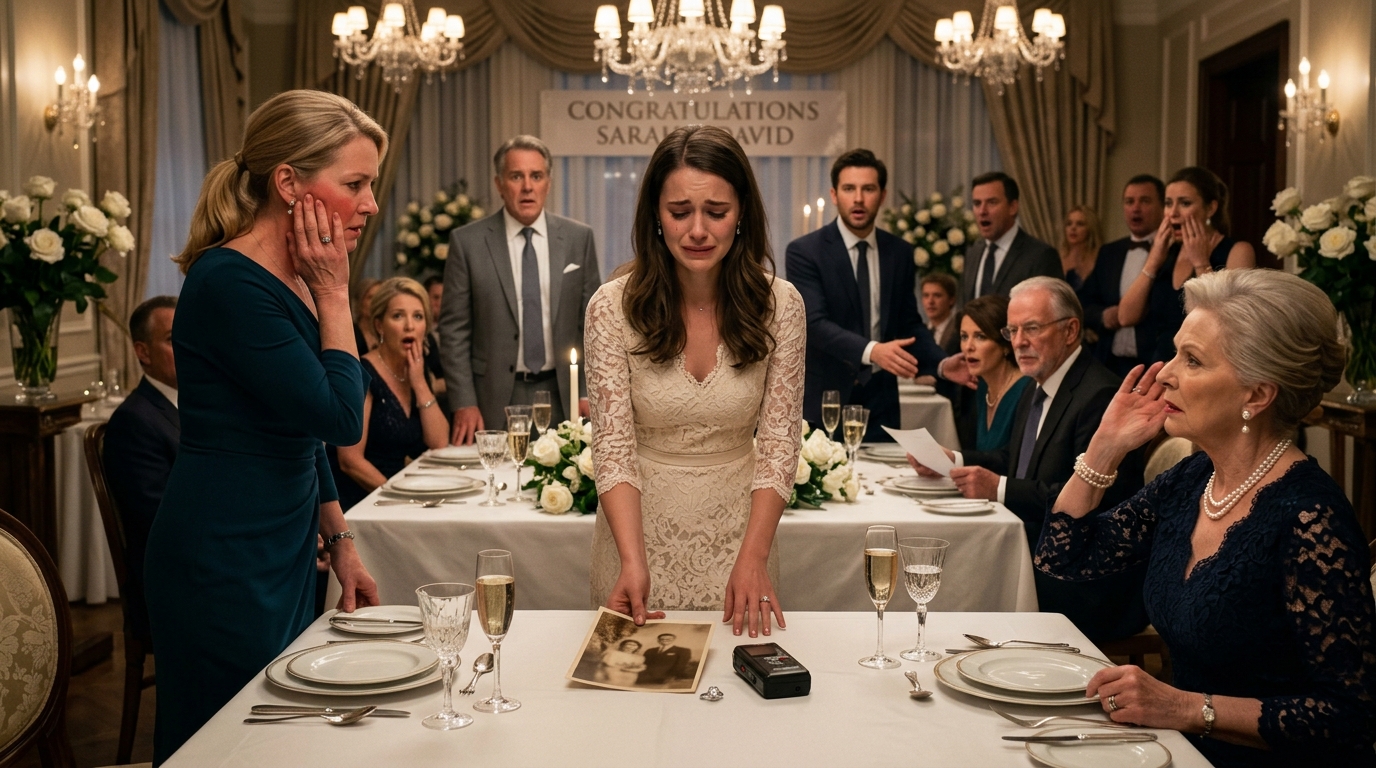
Across the private dining room, nearly forty guests stared at us.
My daughter, Sophie, dropped her engagement bouquet.
Her fiancé, Ethan, froze beside his parents.
My former husband, Charles, remained seated at the head table, looking less surprised than he should have.
That was the moment I knew the slap was not spontaneous.
Someone had prepared Patricia to hate me.
“Mom?” Sophie whispered.
I touched my cheek.
“I’m fine.”
Patricia gave a cold laugh.
“No, you are not fine. And neither is this family now that everyone knows what you did.”
I looked at Sophie.
She appeared terrified.
Not confused.
Terrified.
“What exactly do you think I did?” I asked.
Patricia reached into her handbag and pulled out a thick folder.
“You stole your daughter’s inheritance.”
A murmur moved through the room.
Sophie’s eyes closed.
My heart sank.
For twenty-four years, I had protected her from the truth about her father.
In less than ten seconds, someone had turned that silence into evidence against me.
Sophie was our only child.
When she was eight, Charles and I divorced after fourteen years of marriage.
Publicly, we told people we had grown apart.
Privately, the truth was uglier.
Charles had emptied our joint savings to rescue a failing business he had hidden from me.
He forged my signature on two loan applications.
When the company collapsed, creditors came after our home.
I sold nearly everything I owned to keep Sophie’s life stable.
Charles moved into a luxury apartment three months later.
He told everyone a private investor had saved him.
I knew better.
His wealthy aunt, Margaret, had paid his debts.
Margaret had never married and had no children. She adored Sophie and often said she intended to leave her something substantial.
But when Margaret died six years later, no one showed me the will.
Charles simply said the estate was tied up in litigation.
I asked questions.
He told me to stop being greedy.
By then, Sophie was fourteen.
I decided not to involve her.
That was my mistake.
Years passed.
Charles rebuilt his reputation.
He became the charming father who arrived with expensive gifts and stories about my bitterness.
I became the parent who enforced curfews, paid school fees, and said no when money was tight.
Sophie loved us both, but she admired him.
I understood why.
Charles made life feel easy because someone else was always paying the hidden cost.
At the engagement dinner, Patricia opened the folder and held up a photocopied document.
“This is Margaret Whitmore’s will,” she announced.
I stared at it.
Patricia continued.
“She left two million dollars in trust for Sophie.”
Guests gasped.
Sophie looked at the floor.
“And according to these records,” Patricia said, “her mother became trustee when Sophie was fourteen.”
I felt the room closing around me.
“That is not possible.”
Patricia smiled.
“It gets worse.”
She produced bank statements.
“Within three years, nearly all the money disappeared.”
Ethan turned toward Sophie.
“You knew about this?”
Sophie’s voice shook.
“I found the documents last month.”
“And you didn’t tell me?” I asked.
She looked at me with tears in her eyes.
“I wanted to give you a chance to explain.”
“You never asked me.”
“Every time I tried, you changed the subject.”
“Because I had no idea what you were talking about.”
Charles finally stood.
“Let’s not pretend, Helen.”
I looked at him.
His expression was solemn, almost sad.
It was the face he wore when lying in public.
“You knew Margaret left Sophie money,” he said.
“I knew she intended to.”
“You signed the trust documents.”
“I did not.”
He lowered his voice.
“Helen, this is already painful enough.”
That performance almost impressed me.
I turned toward my daughter.
“Sophie, I have never controlled a trust in your name.”
She began crying.
“Then why is your signature on everything?”
Patricia pushed the papers across the table.
My name appeared on every page.
Helen Brooks, Trustee.
The signature looked like mine.
Not perfectly.
But close enough to convince someone who had seen it only occasionally.
Then I noticed the dates.
Three documents had supposedly been signed in March, seven years earlier.
During that month, I had been in Toronto caring for my dying sister.
I had passport stamps, hospital records, and photographs proving it.
Charles knew that.
He had driven me to the airport.
I looked up.
“You chose the wrong dates.”
For the first time, his expression shifted.
Only slightly.
But I saw it.
“What are you talking about?” Patricia asked.
“I was out of the country when these papers were signed.”
Charles recovered quickly.
“You could have signed them before leaving.”
“The documents were notarized on three different dates.”
He did not answer.
Ethan’s father, Robert, took one of the pages.
He was a retired judge, and until that evening he had spoken very little.
He adjusted his glasses.
“She has a point.”
Patricia turned toward him.
“Charles said—”
“I am reading the dates.”
Charles stepped closer.
“It was a long time ago. Helen may not remember correctly.”
“I remember watching my sister die,” I said. “I remember every day of that month.”
Sophie covered her mouth.
She knew about my sister.
She knew I had been away.
A small crack appeared in her certainty.
But Patricia was not finished.
“Even if one date is questionable, the money still disappeared while you were named trustee.”
“I was never trustee.”
“Then who was?”
No one spoke.
Charles placed one hand on Sophie’s shoulder.
“I did not want tonight to become this.”
I looked at his hand.
He was not comforting her.
He was positioning himself beside her.
The innocent father.
The protective parent.
The man who had waited years for the right audience.
“You brought these documents here,” I said.
“No.”
“Then how did Patricia get them?”
Patricia answered before he could.
“Charles gave them to Ethan privately. He was worried about Sophie’s future.”
Ethan looked uncomfortable.
“He said we should know before the marriage.”
There it was.
Charles had not merely accused me.
He had planted the accusation inside my daughter’s new family and allowed them to reveal it publicly.
He wanted the humiliation to be witnessed.
He wanted Sophie to choose sides in front of everyone.
PART 2
I turned toward him.
“What do you gain if she believes this?”
His eyes hardened.
“I gain nothing.”
“Then why wait until her engagement dinner?”
“I begged Patricia to handle this privately.”
Patricia looked surprised.
“You told me she would deny everything unless confronted in front of witnesses.”
Charles’s jaw tightened.
He had not expected her to repeat that.
Robert looked at him carefully.
“You arranged this confrontation?”
“I arranged nothing.”
Patricia pointed toward me.
“She stole from my future daughter-in-law.”
My cheek still burned from her slap.
But anger was becoming clarity.
Charles had always relied on noise.
If he created enough emotion, people stopped examining facts.
So I stopped defending myself and asked one question.
“Where did the money go?”
Patricia opened another page.
“Three companies received transfers.”
She read the names.
Two meant nothing to me.
The third did.
Northstar Family Holdings.
My stomach turned.
Northstar had been Charles’s failed company.
Or at least, that was what he claimed.
I looked at him.
“You said Northstar closed after our divorce.”
“It did.”
“Then why did it receive Sophie’s trust money four years later?”
The room went silent again.
Charles grabbed the page.
“This must be a clerical error.”
Robert stood and took it from him.
“Sit down.”
Charles stared at him.
Robert’s voice remained calm.
“I said sit down.”
Something about his tone changed the balance in the room.
Charles sat.
Robert began examining the statements.
“Northstar Family Holdings received six transfers over eighteen months,” he said. “The account number is consistent.”
He turned to Charles.
“Were you associated with this company?”
“Years earlier.”
“Who owned it during the transfers?”
“I don’t know.”
“That is difficult to believe.”
Sophie looked at her father.
“Dad?”
He reached for her hand.
“Sweetheart, business structures are complicated.”
“Did your company receive my money?”
“No.”
Robert placed the page on the table.
“That was not the question.”
Charles’s face reddened.
“Are you interrogating me?”
“I am asking why a company connected to you received funds from your daughter’s trust.”
Patricia lowered herself into a chair.
Her confidence was beginning to disappear.
Ethan moved closer to Sophie, but she stepped away from him.
“You all knew about this?” she asked.
Ethan looked ashamed.
“I knew there were documents.”
“You let your mother confront mine?”
“I thought she had stolen from you.”
“So you decided to expose her at our engagement dinner?”
“My mother acted before I could stop her.”
Patricia turned toward him.
“You agreed she needed to answer.”
Sophie stared at the family she was about to marry into.
Then she looked at me.
“I should have come to you.”
“Yes,” I said.
“I didn’t know who to believe.”
“I understand.”
That was true.
But understanding did not remove the hurt.
My daughter had spent a month investigating me in secret.
She had brought me into a room where almost everyone knew an accusation was coming.
And no one had warned me.
Then Sophie did something unexpected.
She reached beneath the table and pulled out a slim black envelope.
Charles looked alarmed.
“What is that?”
She placed it in front of her.
“The reason I did not ask Mom directly.”
I stared at her.
She opened the envelope and removed a photograph.
Then she placed it faceup on the table.
The photograph showed Charles standing outside a bank.
He was younger, perhaps forty-five.
Beside him was a woman I recognized immediately.
Margaret’s longtime attorney, Diane Miller.
Between them, they held a folder bearing the same trust company’s logo as the documents Patricia had brought.
The date printed on the back was two weeks after Margaret’s funeral.
Sophie looked at her father.
“You told me you knew nothing about the trust until last year.”
Charles said nothing.
She placed down a second photograph.
This one showed him entering Northstar’s office three years after he claimed the company had closed.
Then a third.
Charles at dinner with the notary whose stamp appeared on my forged signatures.
“I found these in Aunt Margaret’s storage unit,” Sophie said.
Charles looked stunned.
“You went through her property?”
“It became mine when the storage company contacted me about unpaid fees.”
I had no idea the unit existed.
Neither, apparently, did Charles.
Sophie pulled out a letter.
“Margaret wrote this six months before she died.”
Her hands trembled as she read.
“Sophie’s father has asked me repeatedly to place him in control of the trust. I refused. I do not trust his business judgment, and I fear he views the fund as a solution to his debts.”
Charles stood again.
“That letter proves nothing.”
Sophie looked at him.
“There’s more.”
She removed a small audio recorder.
The moment Charles saw it, his face changed completely.
Not anger.
Fear.
“Where did you get that?”
“Inside Margaret’s safe-deposit box.”
My daughter pressed play.
Margaret’s voice filled the room.
Weak, elderly, but unmistakable.
“I am recording this because Charles came to my home again today. He wants control of Sophie’s trust. I told him Helen should be trustee if anything happens to Diane. Charles became furious. He said Helen would never know the difference if her signature appeared on the papers.”
No one moved.
The recording continued.
“If documents later appear bearing Helen’s signature, they should be treated as fraudulent. I have instructed Diane to preserve copies of all correspondence.”
Sophie stopped the audio.
Charles stared at her.
“You don’t understand the context.”
She laughed once, but there was no humor in it.
“You used Mom’s name.”
“I protected the trust.”
“You emptied it.”
“No.”
“You transferred the money to Northstar.”
“I was investing it.”
“For me?”
“For the family.”
“Which family?”
He had no answer.
Robert gathered the documents into a neat stack.
“This should be reported immediately.”
Charles looked at him.
“You have no authority here.”
“No,” Robert said. “But the police and financial-crimes division will.”
Patricia’s face went pale.
“Police?”
Sophie turned toward her.
“You slapped my mother because you believed the papers Dad gave you.”
Patricia looked genuinely shaken.
“I thought I was defending you.”
“You never asked me what I wanted.”
“I believed—”
“You believed the version that gave you permission to humiliate someone.”
Patricia looked down.
For the first time that evening, she appeared ashamed.
Ethan reached for Sophie.
“We can fix this.”
She pulled her hand away.
“You knew your mother planned to confront my mom.”
“I didn’t know she would hit her.”
“But you knew she planned to accuse her publicly.”
He remained silent.
“That is why you insisted the dinner happen before we signed the marriage agreement,” Sophie said.
I looked at her sharply.
“What marriage agreement?”
Ethan’s expression tightened.
Sophie opened another document.
His family had asked her to sign a prenuptial agreement.
That alone was not unusual.
But one clause required Sophie to disclose all inheritance and trust assets before the wedding.
Another stated that any undisclosed assets discovered later would become jointly managed marital property.
Charles had told Ethan’s family that Sophie possessed a hidden fortune controlled by me.
Ethan’s parents believed forcing the truth into the open would protect their son.
Charles had another motive.
If Sophie recovered the stolen money, he wanted her married into a family arrangement that might complicate ownership and distract investigators from where the funds had gone.
He had turned the engagement dinner into a trap for all of us.
And Ethan had helped set the table.
PART 3
Sophie removed her engagement ring.
Ethan’s face drained of color.
“What are you doing?”
“I am not marrying someone who investigates my mother in secret and invites her into an ambush.”
“I was protecting us.”
“No. You were protecting yourself from the possibility that I might have money you could not control.”
“That isn’t fair.”
“Neither was tonight.”
She placed the ring beside the photograph.
Patricia began crying.
“Sophie, please don’t make a decision while you’re emotional.”
My daughter looked at her.
“You slapped my mother in front of forty people.”
Patricia had no response.
Sophie turned toward me.
“Mom, can we leave?”
Before answering, I looked at Charles.
For years, I had waited for Sophie to see him clearly.
Now that she did, I felt no satisfaction.
Only grief.
A child can discover the truth about a parent and still mourn the person she believed existed.
Charles took a step toward her.
“Sophie, I made mistakes.”
“You framed Mom.”
“I was going to replace the money.”
“With what?”
“The business was recovering.”
“You took nearly two million dollars.”
“I did it for you.”
She stared at him.
“You stole from me and blamed the person who raised me.”
His voice broke.
“I could not let you think I was a failure.”
Sophie’s eyes filled with tears.
“So you made her the villain.”
Charles looked toward me.
For one second, I saw the frightened man beneath the performance.
The man who would rather destroy someone else’s reputation than admit he had failed.
“I thought I could repair everything before anyone knew,” he said.
“That is what you always think,” I replied. “That consequences are only real when other people discover them.”
The police were contacted that night.
The financial investigation lasted almost a year.
The documents bearing my signature were confirmed as forgeries.
The notary admitted Charles had paid him to certify papers I had never signed.
Diane, Margaret’s attorney, had suffered a stroke shortly after the trust was created. During the confusion that followed, Charles submitted replacement documents naming me as trustee while directing all correspondence to an address he controlled.
He then opened accounts using my identity.
The money moved through Northstar and several shell companies.
Some funded business debts.
Some paid for Charles’s apartment and travel.
A large portion had disappeared into failed investments.
He was charged with fraud, forgery, identity theft, and theft from the trust.
Patricia sent me a written apology.
It was twelve pages long.
I read it once.
Then I placed it in a drawer.
An apology mattered, but it did not obligate me to welcome her into my life.
Ethan called Sophie for months.
He insisted he had been misled.
That was partly true.
But being misled did not erase his decision to participate in public humiliation rather than ask a private question.
Sophie ended the engagement.
It broke her heart.
But she later told me losing the wedding was less frightening than marrying into a family that treated suspicion as permission for cruelty.
The trust never recovered its full value.
After legal costs and the remaining assets were traced, Sophie received less than half of what Margaret had intended.
She did not complain.
She used part of it to establish a scholarship for young women studying forensic accounting.
When I asked why, she smiled sadly.
“Because someone should learn how to find the truth before it reaches the dinner table.”
Our relationship also needed repair.
One evening, months after the engagement ended, Sophie came to my house carrying takeout food.
We sat at the kitchen counter.
“I’m sorry I didn’t trust you,” she said.
“I understand why the papers frightened you.”
“That isn’t the same as forgiving me.”
“No.”
She waited.
I could have told her everything was fine.
That would have been easier.
Instead, I told the truth.
“You let people prepare an accusation against me. You invited me into a room where I was the only person who did not know I was on trial.”
She began crying.
“I know.”
“That hurt.”
“I know.”
“But I also know your father spent years teaching you that truth was something he controlled.”
She looked at me.
“Why didn’t you tell me what he did during the divorce?”
“Because I wanted you to love him without carrying my anger.”
“Did protecting me help?”
I thought carefully.
“Sometimes protection becomes another kind of silence.”
That was the lesson I had resisted for years.
I believed hiding Charles’s behavior preserved Sophie’s relationship with him.
Instead, it allowed him to shape the story.
By refusing to speak, I left a space.
He filled it with lies.
Today, the photograph from the engagement dinner remains in my desk.
Not the one of Charles outside the bank.
Another photograph.
It was taken seconds before Patricia slapped me.
Sophie and I are standing beneath the white roses.
She is holding my hand.
We are both smiling, unaware of what is about to happen.
For a long time, I hated that picture.
Now I see it differently.
It captured the final moment of a family story built on appearances.
The loving father.
The respectable future in-laws.
The perfect engagement.
The difficult ex-wife who supposedly wanted money.
Within minutes, every role began to collapse.
Patricia believed she was exposing a thief.
Ethan believed he was protecting his future.
Charles believed one more lie would save his reputation.
Sophie believed silence meant guilt.
And I believed that years of doing the right thing would speak for themselves.
We were all wrong about something.
Character does not always defend itself in a dramatic moment.
Sometimes lies arrive first, carrying documents and witnesses.
Sometimes the truth enters quietly through a photograph placed on a table.
But once it is seen clearly, it changes every face in the room.
My daughter lost an engagement that night.
I lost the last illusion that her father might eventually become honest.
Patricia lost the certainty that wealth and confidence made her judgment reliable.
And Charles lost the story he had spent years forcing everyone else to believe.
But Sophie and I recovered something more valuable than the missing money.
We learned that trust should not mean avoiding difficult questions.
It should mean bringing those questions to the person you love before strangers turn them into weapons.
Because families are rarely destroyed by one revealed secret.
They are destroyed by the people who decide humiliation is easier than conversation—and by the silence that allows the wrong person to control the truth.