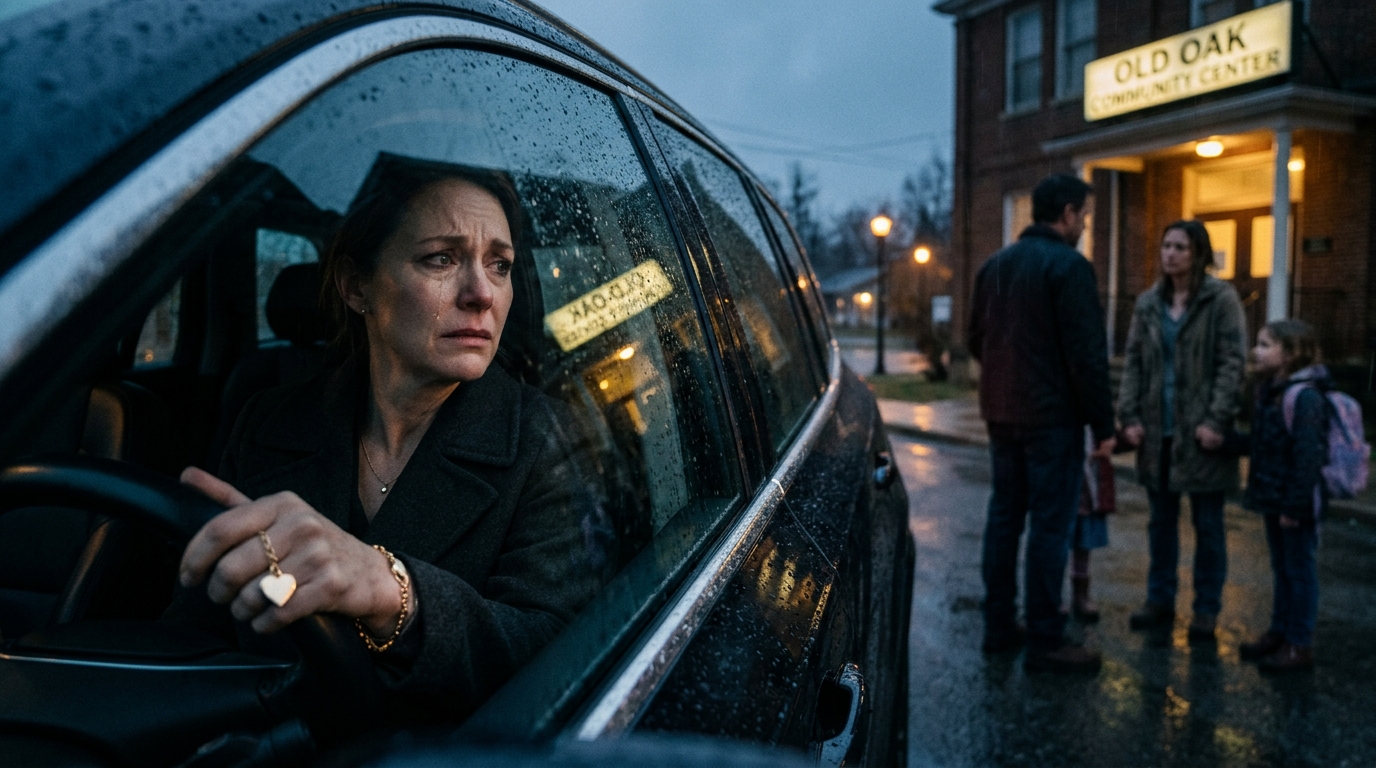
For fifteen years, my husband, Daniel, came home at exactly 6:20 every evening.
He was predictable in the comforting way that long marriages often become predictable. He would park in the same spot, leave his shoes beside the door, kiss my forehead, and ask what was for dinner—even when he could already smell it from the hallway.
Then, without warning, everything changed.
At first, he was only twenty minutes late.
Then forty.
Within two weeks, he had started coming home after nine.
Every time I asked where he had been, he gave me the same vague answer.
“Work has been complicated.”
But Daniel had never been good at lying.
Whenever he hid something, he rubbed the side of his thumb against his wedding ring.
And now, every time I questioned him, he did exactly that.
I tried to tell myself I was imagining things.
We had built a quiet life together. We had survived unpaid bills, the loss of my mother, two miscarriages, and years when we barely had enough money to repair the leaking roof.
Daniel had been the person I trusted most in the world.
But trust does not always disappear in one dramatic moment.
Sometimes, it fades through unanswered questions, guarded phones, and conversations that end too quickly.
One evening, while Daniel was showering, his phone vibrated on the kitchen counter.
The message preview contained only five words:
Same place tomorrow. Don’t be late.
My stomach tightened.
The sender was saved as “M.”
When Daniel walked into the kitchen, I was still holding the phone.
“Who is M?” I asked.
He stopped moving.
For a moment, neither of us spoke.
Then he took the phone from my hand.
“Someone from work.”
“Someone from work who meets you every night?”
“It isn’t what you think.”
“That is what people say when it is exactly what you think.”
His expression hardened.
“You went through my phone?”
“It lit up in front of me.”
“You still read the message.”
“And you are still refusing to explain it.”
Daniel looked toward the floor.
“I can’t tell you yet.”
That sentence hurt more than any confession could have.
Not because it proved he was unfaithful, but because it confirmed that there was now a part of his life from which I had been deliberately excluded.
That night, we slept on opposite sides of the bed.
The space between us felt wider than the room.
Over the next few days, I noticed more things.
Daniel began carrying a second shirt in his car.
He withdrew cash from our account twice in one week.
He started taking calls outside.
Once, while sorting laundry, I found a small gold bracelet in the pocket of his coat.
It was delicate, with a tiny heart-shaped charm.
I stared at it for a long time.
Daniel had not bought me jewelry in years.
By then, my fear had turned into certainty.
I imagined another woman waiting for him.
Perhaps she was younger.
Perhaps she listened to him in ways I no longer did.
Perhaps all those late nights were not sudden at all. Perhaps I had simply been too trusting to notice.
The following Thursday, Daniel said he would be home late again.
I waited ten minutes after he left work.
Then I followed him.
He did not drive toward our neighborhood.
He crossed town and turned into an older district filled with narrow streets and aging apartment buildings. Eventually, he parked outside a small community center.
I stayed far enough behind that he would not see me.
Daniel entered through a side door.
A few minutes later, a woman arrived.
She appeared to be in her early thirties. She had dark hair, a tired face, and a little girl holding her hand.
The girl wore the gold bracelet I had found in Daniel’s pocket.
I felt as though something inside me had cracked.
The woman hugged Daniel.
He knelt and opened his arms to the child.
She ran toward him.
I could not watch any longer.
I drove home with tears blurring the road.
When Daniel returned that night, I was sitting at the dining table with my suitcase beside me.
He looked at it, then at me.
“What is this?”
“I followed you.”
His face lost all color.
I laughed bitterly.
“You should have seen your expression.”
“Claire, please let me explain.”
“I saw her.”
He placed his keys on the table.
“And the little girl?”
He closed his eyes.
“Yes.”
“How long?”
“Six months.”
The answer felt like a knife.
“Six months?”
“Please sit down.”
“I have been sitting here for fifteen years while you built another life behind my back.”
“It is not another life.”
“Then what is it?”
Daniel pulled out a chair but did not sit.
“The woman’s name is Maya.”
I said nothing.
“She is not someone I am having an affair with.”
“Then why did she hug you?”
“Because she is grateful.”
“For what?”
Daniel took a slow breath.
“Her husband was my younger brother.”
I stared at him.
Daniel had only ever spoken briefly about his brother, Adrian. I knew they had been separated as children after their parents divorced. Daniel had gone with his father, while Adrian stayed with their mother.
They had not spoken in more than twenty years.
“Adrian died last year,” Daniel continued.
“What?”
“He had cancer.”
“Why didn’t you tell me?”
“Because I didn’t know until after he was gone.”
Daniel finally sat across from me.
“He left a letter with Maya. He asked her to find me.”
I looked toward the suitcase.
The anger was still there, but now it had nowhere certain to land.
“The little girl is his daughter?”
Daniel nodded.
“Her name is Lily.”
I remembered the way she had run into his arms.
“Why did you hide them from me?”
His eyes filled with shame.
“Because Adrian died believing I hated him.”
Daniel explained that when they were teenagers, their parents had turned them against each other. Each brother had been told that the other had chosen to leave.
For years, Daniel believed Adrian wanted nothing to do with him.
Adrian had believed the same.
By the time the truth came out, pride had done what distance could not.
Neither of them made the first call.
Then Adrian became sick.
“He wrote that he wanted to contact me,” Daniel said. “But he was afraid I would reject him. He asked Maya to wait until after his death.”
Daniel covered his face with both hands.
“I spent half my life being angry with someone who was waiting for me to come back.”
The room became painfully quiet.
I wanted to comfort him.
But another question stood between us.
“Why didn’t you tell me when Maya found you?”
“Because I was ashamed.”
“Of what?”
“Of everything.”
He looked at me.
“I was ashamed that I let pride steal my brother from me. I was ashamed that his daughter needed help and I had not even known she existed. And I was afraid you would ask why I never tried harder to find him.”
“I would have helped you.”
“I know.”
“Then why lie?”
Daniel’s voice dropped.
“Because once I hid the first meeting, every meeting after that became harder to explain.”
He told me Maya was struggling financially. Adrian’s medical treatment had left behind debt, and Lily needed surgery for a hearing condition.
Daniel had been spending his evenings helping at the community center, where Maya worked part-time. The cash withdrawals had gone toward Lily’s medical bills.
The extra shirt was because he changed after repairing damaged rooms at the center.
The bracelet had broken, and Daniel had taken it to be repaired.
“M” was Maya.
Every suspicious detail had an explanation.
But explanations do not automatically repair trust.
“You let me believe the worst,” I said.
“I never wanted that.”
“You watched me become afraid, and you still chose silence.”
“I thought I was protecting you from my mess.”
“No. You were protecting yourself from an uncomfortable conversation.”
Daniel looked down.
He knew I was right.
That night, I did not leave.
But I did not unpack my suitcase either.
For the first time in our marriage, love was not enough to make everything feel safe.
During the following weeks, Daniel told me the whole story.
Not just about Maya and Lily, but about Adrian.
He showed me the letter.
It had been folded so many times that the paper was beginning to tear.
Adrian had written about childhood memories Daniel had almost forgotten: sharing a bicycle, sleeping beneath the kitchen table during thunderstorms, and promising they would one day live next door to each other.
The final paragraph was the hardest to read.
I don’t know which one of us should have called first. I only know that we both waited too long. Please don’t let Lily grow up believing she has no family.
Daniel cried while I read it.
So did I.
A few days later, I met Maya and Lily.
Maya was nothing like the woman I had invented in my mind.
She looked exhausted and cautious. When she saw me, she apologized immediately.
“I told Daniel he should tell you,” she said.
“He should have.”
Daniel did not defend himself.
Lily sat beside me and showed me her bracelet.
“Uncle Daniel fixed it,” she said.
The word “uncle” changed something in the room.
Not everything.
But something.
Over time, we began helping Maya together.
I drove Lily to medical appointments when Maya had to work. Daniel continued repairing the community center. We invited them to dinner on Sundays.
But inside our home, the damage remained.
I questioned things I had never questioned before.
When Daniel was late, I felt panic.
When his phone rang, I looked at his face.
When he said, “Trust me,” I discovered that those words no longer carried the same weight.
One evening, I finally told him the truth.
“I believe you were not unfaithful.”
He looked relieved.
“But I still do not trust you.”
The relief disappeared.
“I don’t know how to fix that,” he said.
“You cannot ask me to forget.”
“I know.”
“You cannot explain it once and expect everything to return to normal.”
“I know.”
“You have to become honest before I ask questions, not after I discover answers.”
Daniel nodded.
And then he did something I did not expect.
He stopped asking me to forgive him quickly.
Instead, he started showing up.
He told me where he was going without being asked.
He invited me into difficult conversations.
He admitted when he felt ashamed, afraid, or confused.
When he made mistakes, he spoke before silence turned them into secrets.
Months passed.
Trust returned slowly, not as the innocent certainty we once had, but as something more deliberate.
Something rebuilt.
Lily’s surgery was successful.
On the day she heard clearly for the first time, she laughed at the sound of birds outside the hospital window.
Daniel turned away and cried.
Later, he told me Adrian would have loved that moment.
“I wish he were here,” he said.
“So do I.”
A year after I followed Daniel, we visited Adrian’s grave together.
Daniel placed two small toy bicycles beside the headstone.
For the brothers he and Adrian had once been.
He stood there for a long time.
“I thought silence kept me safe,” he said. “But it cost me my brother, and it nearly cost me my marriage.”
I held his hand.
The lesson was not that suspicion is always wrong.
Sometimes our fears are telling us that something truly has changed.
The lesson was also not that love requires blind trust.
Blind trust is not love. It is avoidance.
What our marriage taught us was something harder:
Trust is not built by never making mistakes.
It is built by having the courage to reveal the truth before the person you love is forced to search for it.
Daniel had not betrayed me with another woman.
But he had betrayed the openness on which our marriage depended.
And I had learned something about myself too.
Fear had allowed me to create an entire story before I knew the facts. I had turned incomplete evidence into certainty because certainty—even painful certainty—felt easier than not knowing.
We both had work to do.
He had to stop hiding.
I had to stop assuming.
Neither lesson erased what happened.
But together, they gave us a way forward.
Today, Daniel still comes home at 6:20 most evenings.
Sometimes he is late.
The difference is that now he calls.
And when something is difficult, he no longer says, “I can’t tell you yet.”
He sits beside me and tells me the truth, even when it makes him look weak.
Especially then.
Because a marriage rarely ends from one secret alone.
It ends when two people become more comfortable protecting themselves than being known by each other.
And sometimes, the strongest promise a husband and wife can make is not simply, “I will never hurt you.”
It is this:
When the truth is difficult, I will still bring it home.