The first time I noticed my daughter sneaking out of the house, it was four in the morning.
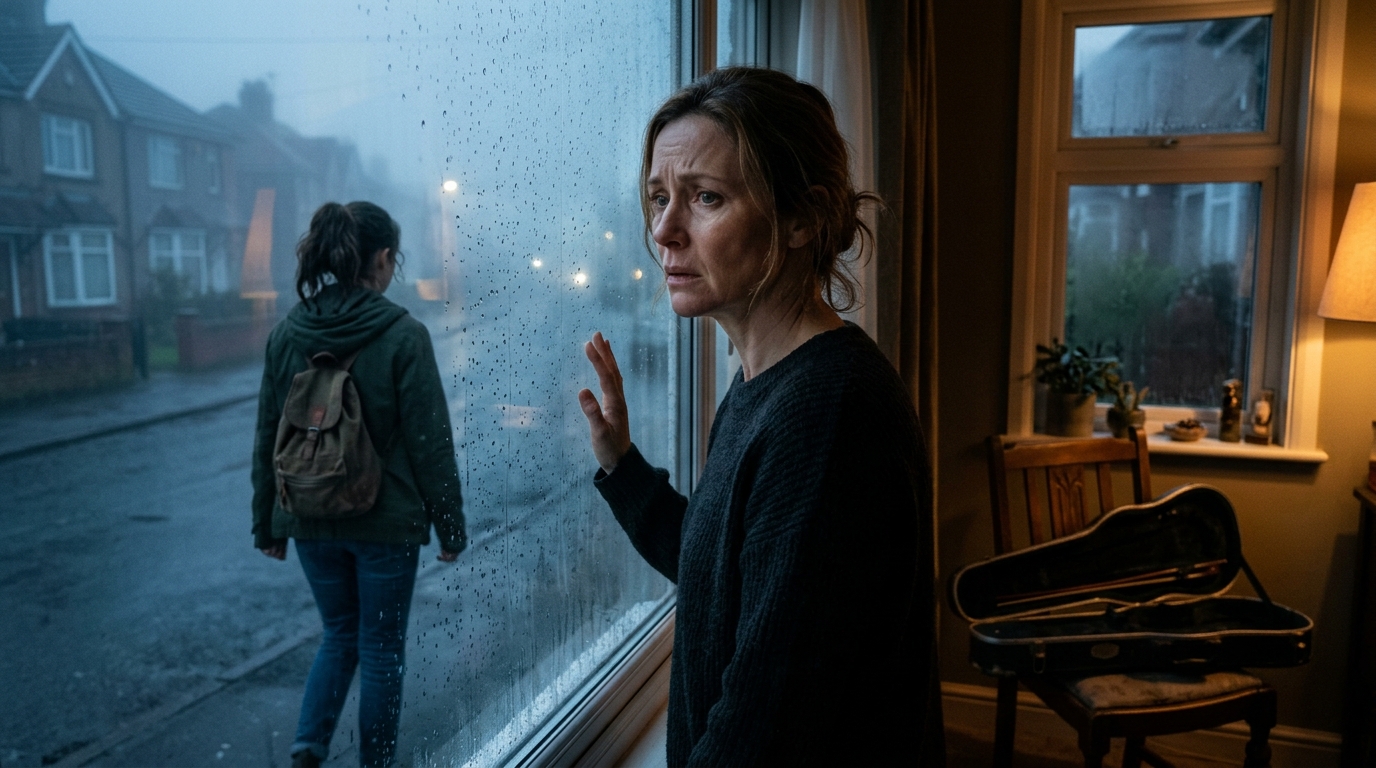
I woke to the faint sound of the back door closing and footsteps disappearing across the wet grass. At first, I thought I had imagined it. Our old house made strange noises at night, especially when the wind pushed through the loose window frames.
But when I walked into sixteen-year-old Emma’s bedroom, her bed was empty.
Her blanket had been arranged beneath the covers to resemble a sleeping body. Her phone was gone, and the small wooden box she kept inside her closet was lying open on the floor.
I stood there in the darkness, staring at the empty bed.
Emma had never been a difficult child.
She was quiet, thoughtful, and unusually mature for her age. After her father died three years earlier, she had become even more protective of me. She cooked dinner when I worked late, reminded me to take my medicine, and always pretended not to notice when I cried in the laundry room.
That was why her secret frightened me.
The next morning, she appeared at breakfast as if nothing had happened.
Her hair was damp from a shower, and there was mud along the edge of one sneaker.
“Did you sleep well?” I asked.
She avoided my eyes. “Mostly.”
“Were you outside last night?”
Her spoon stopped halfway to her mouth.
For one brief second, I saw panic cross her face.
Then she smiled.
“No. Why?”
I wanted to confront her. I wanted to tell her that lying would only make things worse. But something in her expression stopped me. She did not look defiant.
She looked afraid.
Over the following two weeks, Emma changed.
She stopped eating breakfast. She came home late from school and locked herself in her room. Sometimes, I heard her whispering on the phone. Whenever I entered, she ended the call immediately.
Money also began disappearing from the jar above the refrigerator.
It was not much at first—ten dollars, then twenty. One evening, I counted the emergency cash and discovered nearly three hundred dollars was missing.
When I asked Emma about it, her face turned pale.
“I needed it,” she said.
“For what?”
“I can’t tell you.”
“You took money without asking.”
“I know.”
“Are you in trouble?”
Her eyes filled with tears, but she quickly looked away.
“No.”
“Is someone threatening you?”
“No.”
“Then tell me what is happening.”
She gripped the edge of the kitchen counter.
“I’m trying to fix something.”
“What?”
She shook her head.
“You’ll understand soon.”
That answer kept me awake all night.
The next morning, I called her school.
Her teacher told me Emma had missed several classes during the past month. She had also withdrawn from the spring music competition, even though she had spent nearly a year practicing for it.
That frightened me more than the missing money.
Music had been Emma’s whole world.
Her father had given her a secondhand violin when she was nine. It was scratched and worn, but she treated it like treasure. After he died, she played every evening because she said the sound made her feel as though he were still in the room.
But when I checked beneath her bed that afternoon, the violin case was gone.
I searched the entire house.
It was nowhere.
That evening, Emma returned home carrying two grocery bags.
“Where is your violin?” I asked.
She froze.
“At school.”
“I called the school.”
Her shoulders dropped.
“What did you do with it?”
She said nothing.
“Emma, did you sell it?”
Her silence gave me the answer.
I felt anger rise inside me.
“That violin belonged to your father.”
“I know.”
“It was the last gift he gave you.”
“I know.”
“Then how could you sell it?”
Her face crumpled.
“Because I had to.”
“You did not have to do anything. You chose to keep secrets, steal money, skip school, and sell something your father gave you.”
“I’m sorry.”
“That is not enough.”
She placed the grocery bags on the floor and ran upstairs.
I almost followed her.
But I was too angry.
That decision would haunt me for the rest of my life.
Two days later, I found a folded hospital document in the pocket of Emma’s coat.
At the top of the page was my name.
Below it were details from my most recent medical examination.
I had been diagnosed with a serious heart condition six months earlier. The doctor had explained that I would eventually need surgery. Without it, my condition could become life-threatening.
I had not told Emma the full truth.
I told her it was minor.
I told her medication would be enough.
I told her not to worry.
But the paper in my hand contained the truth: the surgery was urgent, and without proper treatment, my chances were uncertain.
There were handwritten numbers in the margin.
Hospital fees.
Medication costs.
Transportation expenses.
At the bottom, Emma had written one sentence:
I just need a little more time.
My hands began to shake.
I searched her room again, this time more carefully.
Behind a row of books, I found envelopes filled with cash. Inside the wooden box were pawnshop receipts, a list of household expenses, and a notebook recording every dollar she had earned.
Babysitting.
Cleaning houses.
Delivering newspapers before sunrise.
Working at a bakery on weekends.
Selling her violin.
Emma had not been sneaking out to meet someone.
She had been working.
She had missed school because she was trying to raise money for my surgery.
I sat on the floor and cried.
All those mornings I had accused her in my mind.
All those evenings I had watched her drag herself upstairs.
All those times she had said she was trying to fix something.
She had been trying to save me.
When Emma came home, I was waiting in the living room with the notebook in my lap.
She stopped in the doorway.
“You found it.”
“Why didn’t you tell me?”
She looked down.
“Because you would have stopped me.”
“You are sixteen.”
“And you’re my mother.”
“It is not your responsibility to pay for my surgery.”
“It is my responsibility not to lose you.”
Her voice broke on the final word.
I crossed the room and held her.
For the first time in months, she allowed herself to cry.
“I already lost Dad,” she whispered. “I couldn’t lose you too.”
I promised her we would find another way.
I promised she would return to school.
I promised we would try to recover her violin.
Most importantly, I promised I would stop hiding the truth from her.
That night, we sat together at the kitchen table and counted the money she had saved.
It was far from enough for the surgery, but it represented hundreds of hours of work and sacrifice.
I wanted to feel proud.
Instead, I felt guilty.
My daughter had been carrying a fear no child should have to carry.
The following morning, Emma did not wake up.
At first, I thought she was exhausted.
I touched her shoulder and called her name.
She did not move.
Her skin was cold.
The ambulance arrived within minutes, but every second felt endless.
At the hospital, a doctor asked whether Emma had complained about headaches, dizziness, or fainting.
I remembered how she had leaned against the kitchen counter.
How she had stopped eating.
How pale she had become.
I had believed she was hiding guilt.
She had been hiding pain.
Tests revealed that Emma had a rare blood vessel disorder. It had likely been developing silently for years. The long work hours, lack of sleep, and constant physical strain had placed enormous pressure on her body.
She needed emergency surgery.
I sat beside her hospital bed before they took her away.
Machines beeped around us. A nurse adjusted the blanket across her chest.
Emma opened her eyes for only a moment.
“Mom?”
“I’m here.”
“Did we get enough?”
I swallowed my tears.
“Yes,” I lied. “You did more than enough.”
She gave me a weak smile.
“Then you’ll be okay.”
“No,” I said, holding her hand tightly. “We will both be okay.”
But this time, she knew I was lying.
Her fingers tightened around mine.
“Use the money,” she whispered.
“Emma—”
“Please.”
“For what?”
“For your heart.”
I leaned closer, pressing her hand against my cheek.
“You are my heart.”
A tear slipped from the corner of her eye.
Then the nurses wheeled her away.
The surgery lasted several hours.
Emma never woke up.
The doctors said the damage had been too severe.
They said there was nothing more anyone could have done.
But I did not believe them.
I could have listened more carefully.
I could have asked better questions.
I could have followed her instead of judging her.
I could have seen that her silence was not rebellion.
It was love.
Weeks after the funeral, the bakery owner visited my house.
He brought a small package wrapped in brown paper.
Inside was Emma’s violin.
“She came here every afternoon,” he told me. “When I learned why she was working, I contacted the pawnshop. Everyone at the bakery contributed to buy it back.”
There was an envelope inside the violin case.
Emma had written the letter before her final day at the hospital.
Mom,
I know you will be angry when you discover everything. But Dad once told me that love means giving someone the part of yourself they need most. You gave me your strength when he died. I only wanted to give some of it back.
Please have the surgery. Please keep living. And when you miss me, open the window and play the violin, even if you play badly. I’ll hear it.
Love,
Emma
I had the surgery three months later.
The money Emma saved covered only a small portion of the cost, but after her story spread through our community, friends, neighbors, teachers, and complete strangers helped pay the rest.
The operation saved my life.
People often tell me that Emma would be happy to know her sacrifice was not wasted.
Perhaps they are right.
But every morning, when sunlight enters her empty bedroom, I would trade every remaining beat of my repaired heart for one more chance to hear her footsteps in the hallway.
I still have her violin.
I never learned how to play it properly.
But every year, on her birthday, I sit beside the open window and draw the bow across the strings.
The sound is unsteady and broken.
Yet sometimes, when the wind moves through the room, I imagine another note rising beside mine—soft, clear, and familiar.
And for one fleeting moment, it feels as though my daughter is still telling me the same thing she tried so hard to prove:
Love does not always announce itself.
Sometimes, it leaves before dawn, carries burdens in silence, and gives everything it has—before we finally understand the truth.